
What Is Closed-Loop Recycling in Die Casting?
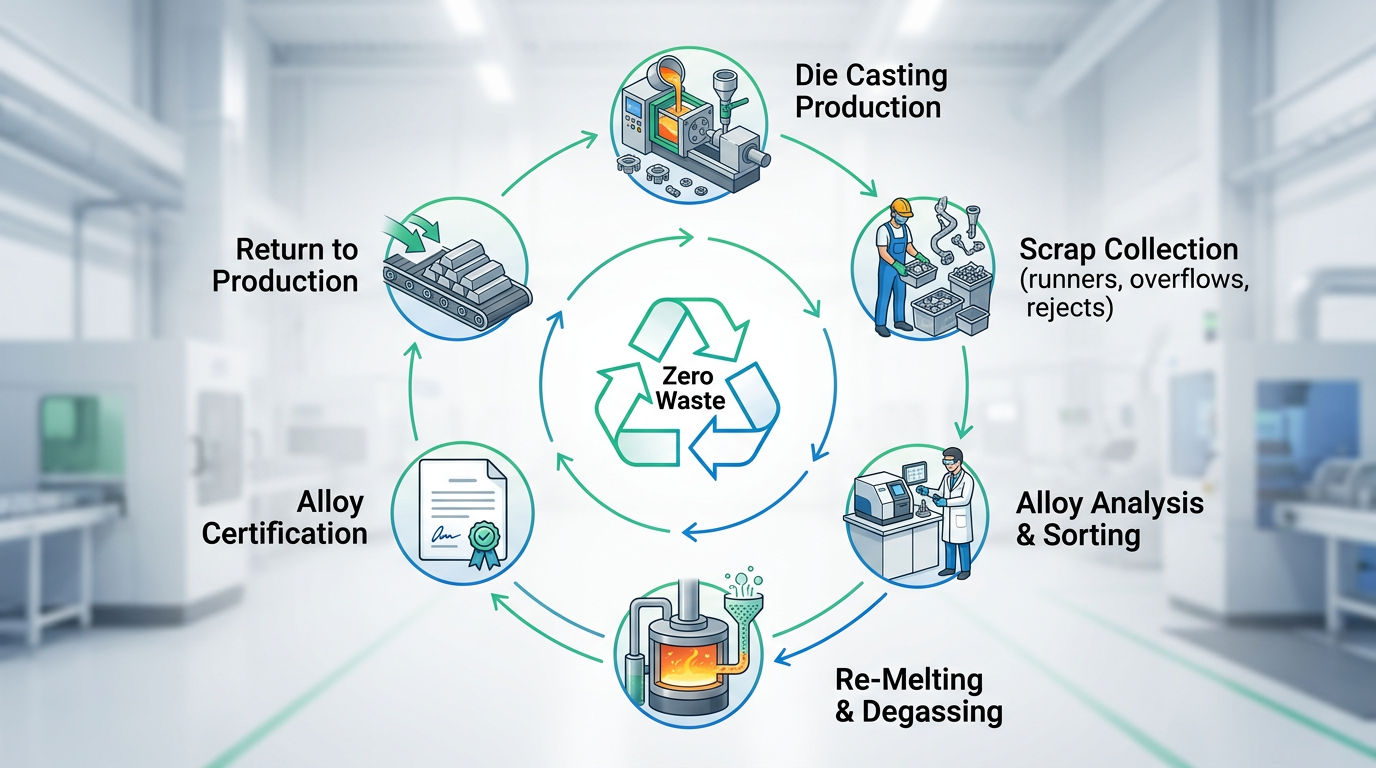
Closed-loop recycling in die casting means collecting scrap aluminum from production, melting it down, and reusing it to make new castings within the same facility or supply chain. This keeps material within a controlled loop, allowing for consistent alloy composition and quality control without the uncertainties of open-market recycling.
The distinction from open-loop recycling is fundamental. In an open-loop system, casting scrap is sold to general recyclers, mixed with material from diverse sources, and reintroduced into the market as commodity aluminum. This introduces contamination risks. Iron, copper, silicon, and other trace elements accumulate with each cycle. For die casting, where alloy purity matters for structural performance, open-loop material is often unsuitable without extensive refining.
Closed-loop systems eliminate this problem. Scrap is collected by alloy type, stored separately, and remelted on-site or at a dedicated partner facility before being recast. The material stays within the same production ecosystem. More than 80% of aluminum in European die casting now comes from recycled sources, and closed-loop systems are the mechanism driving this shift.
For manufacturers, closed-loop recycling has multiple benefits: it reduces raw material costs, cuts carbon emissions dramatically, improves supply chain resilience, and meets growing OEM sustainability requirements. The barrier to entry is lower than greenfield aluminum smelting, yet the competitive advantage is significant.
BMW's Pioneering System
BMW's Munich die casting plant is the gold standard for closed-loop recycling in the automotive industry. The system collects scrap aluminum from battery housing production, melts it on-site, and recasts new housings using 100% recycled aluminum. This is not incremental improvement; it is a fundamental redesign of the production workflow to capture and reuse every kilogram of material.
The results are staggering. BMW's closed-loop system cuts carbon emissions by 85% compared to using virgin aluminum. This is not a minor reduction. For context, virgin aluminum production requires electrolytic reduction of bauxite ore, an energy-intensive process that generates significant CO2 emissions. Recycling bypasses this entirely, requiring only melting and reprocessing.
Key Achievement: BMW's Munich facility cut carbon emissions by 85% by implementing closed-loop aluminum recycling for battery housing production. BMW plans to expand this system to all its global die casting plants by 2026, setting a new industry standard.
The implementation required significant capital investment in melting infrastructure, scrap handling systems, and alloy tracking. BMW also redesigned its casting alloys to work with high recycled content, addressing the challenge of trace element accumulation. The company invested in advanced quality control and material traceability systems to ensure recycled aluminum meets the same structural standards as virgin material.
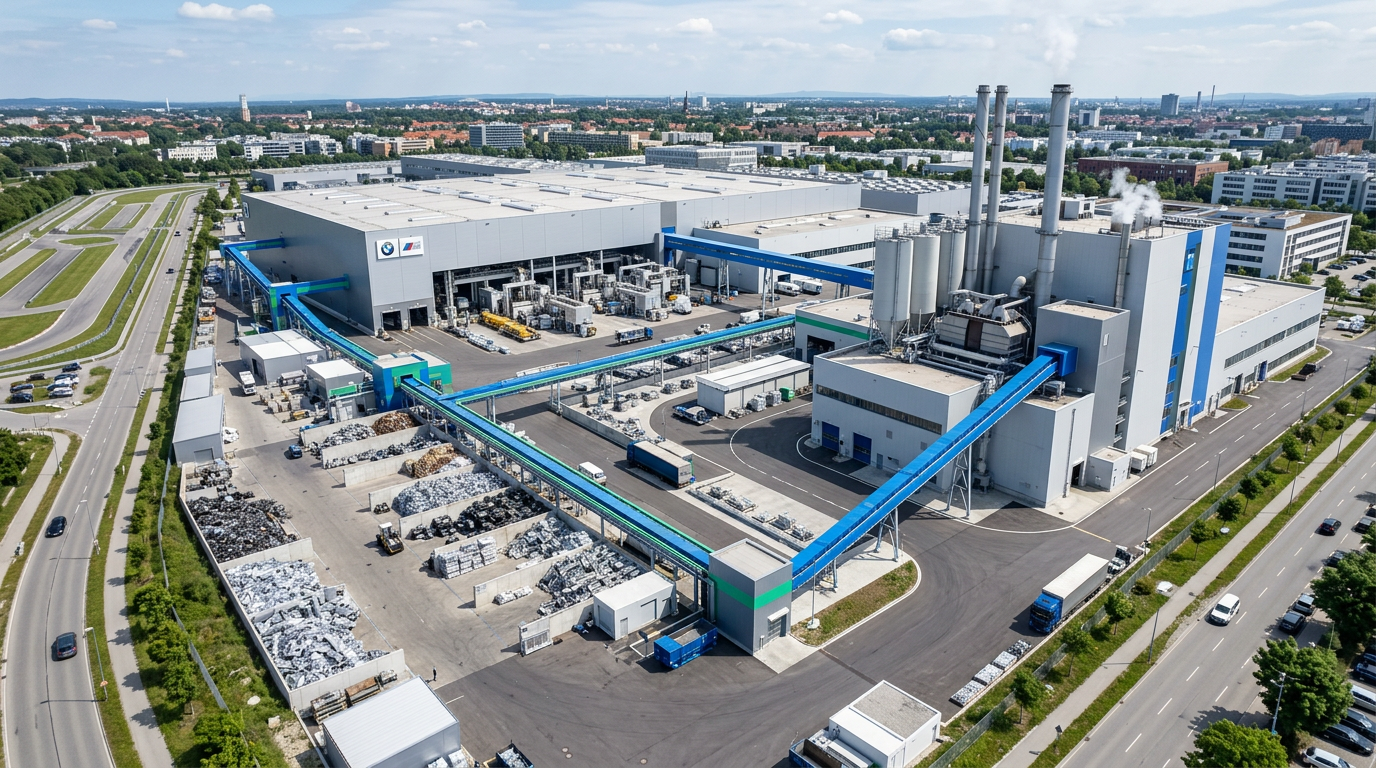
BMW's roadmap is clear: by 2026, the company will deploy closed-loop systems at all its die casting plants globally. This is not a pilot program. It is a corporate commitment backed by capital allocation and engineering resources. For BMW suppliers, this means compliance is not optional; it is a condition of future contracts.
The Numbers: Why Recycling Makes Sense
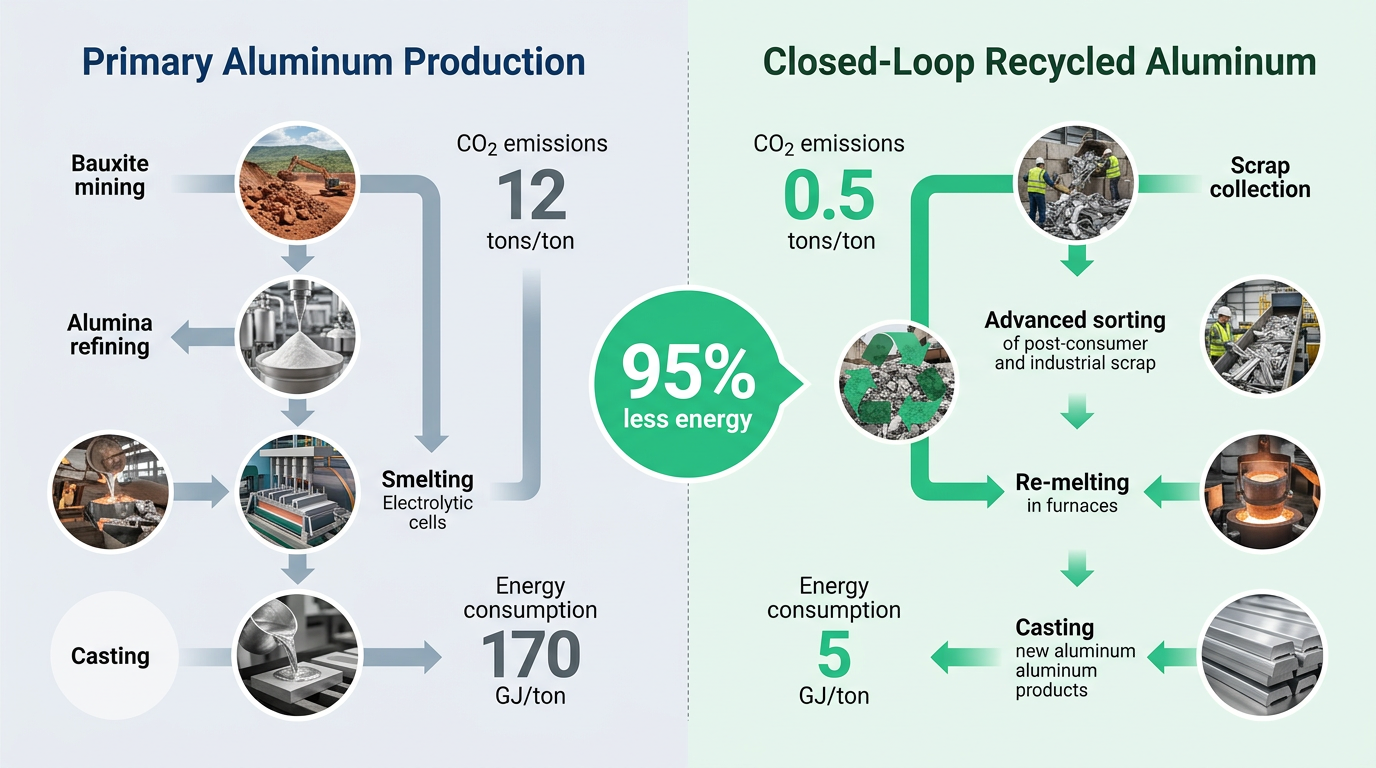
The economics of closed-loop recycling are compelling. Recycling aluminum saves up to 95% of the energy required for primary production. In practical terms, this means producing one kilogram of recycled aluminum requires roughly 5% of the energy needed to extract and process virgin aluminum from ore. For a die caster processing thousands of kilograms per day, this translates to massive energy cost savings.
Modern closed-loop systems can achieve recycling rates up to 98%, meaning that for every 100 kilograms of material produced, 98 kilograms are recovered and reused. Raw material consumption is reduced by 30-40% through in-house recycling. When combined with energy-efficient melting techniques and optimized casting processes, additional 30-50% energy savings are possible beyond the baseline recycling benefit.
Global demand for sustainable aluminum is expected to grow 50% by 2030, according to the International Aluminum Institute. This is not speculative; it reflects concrete OEM commitments and regulatory pressure, particularly in Europe. Manufacturers who invest in closed-loop systems now will capture a disproportionate share of this growing market segment.
Virgin Aluminum Production
- Energy consumption: 100% baseline
- CO2 emissions: High (typically 12-14 kg CO2/kg)
- Raw materials: Bauxite mining required
- Processing: Electrolytic reduction, refining
- Lead time: 3-6 weeks supply chain
Closed-Loop Recycled
- Energy consumption: 5% baseline
- CO2 emissions: Low (0.6-0.8 kg CO2/kg)
- Raw materials: On-site scrap collection
- Processing: Melting and reprocessing
- Lead time: 1-2 weeks in-house cycle
The cost advantage is equally clear. A die caster investing in melting infrastructure pays capital upfront but recaptures cost through lower raw material purchases, reduced energy bills, and premium pricing for recycled-content castings. Payback periods are typically 3-5 years depending on production volume and electricity costs.
Industry-Wide Adoption
BMW is not alone. The entire automotive supply chain is rapidly adopting closed-loop recycling models. This is being driven by two forces: OEM sustainability mandates and regulatory pressure from the EU Carbon Border Adjustment Mechanism (CBAM).
OEMs are now requiring suppliers to report the carbon footprint per part and to demonstrate continuous improvement in sustainability metrics. Tier 1 suppliers are cascading these requirements down the supply chain, mandating that their die casting partners implement recycling and carbon reduction strategies. For manufacturers without recycling capability, the result is simple: exclusion from major automotive RFQs.
Regulatory Pressure: The EU's Carbon Border Adjustment Mechanism (CBAM) imposes tariffs on carbon-intensive imports starting in 2026. Aluminum products with high embodied carbon will face tariffs, creating a cost penalty for virgin aluminum and a competitive advantage for recycled content. This regulatory shift will accelerate closed-loop adoption across European manufacturers.
CBAM is a game-changer. The mechanism taxes imported goods based on their carbon content. Aluminum produced from recycled sources has dramatically lower embodied carbon than virgin aluminum. This means CBAM tariffs will effectively make virgin aluminum more expensive and create a price advantage for recycled-content manufacturers. This is not a soft incentive; it is a hard economic constraint that will force supply chain restructuring.
Beyond BMW, companies like Nemak, Actual, and other Tier 1 die casters are investing in closed-loop capacity. Nemak's recent capital allocation emphasizes sustainability, including recycling infrastructure expansion. Actual Technologies has announced investments in electric arc furnace capacity, which pairs well with closed-loop recycling operations. The market is signaling that this is not a niche capability; it is the future baseline for automotive casting.
Low-Carbon Alloys and New Standards
Closed-loop recycling works best when paired with specialized alloy formulations designed for high recycled content. New low-carbon alloy families are emerging to address this gap. These alloys reduce CO2 emissions by up to 50% during production compared to conventional formulations, through optimized melting temperatures, reduced processing time, and chemistry adjustments that improve recyclability.
The technical challenge is trace element management. As aluminum is recycled, iron, copper, silicon, and other elements accumulate with each cycle. Traditional open-loop recycling tolerates this contamination by using alloys with broader composition windows. But closed-loop systems require tighter control.
Advanced sorting and refining technologies are solving this problem. Spectroscopic sorting systems can separate aluminum scrap by alloy family with 98% accuracy before melting. Post-melting, specialized refining processes remove trace elements through selective oxidation, settling, or advanced filtration. The result is recycled aluminum that meets primary specification requirements for critical casting applications.
New industry standards are emerging to validate recycled content and carbon reduction claims. The Aluminum Stewardship Initiative (ASI) is establishing certification frameworks for responsible sourcing and recycling. ISO 14001 environmental management systems are becoming standard requirements for suppliers. These certifications provide third-party validation that closed-loop systems are delivering genuine environmental benefit, not just marketing claims.
For manufacturers, this means that investing in certified recycling systems creates a defensible competitive position. ASI-certified recycled aluminum commands premium pricing in OEM supply chains. It is a tangible way to monetize sustainability investments.
What Manufacturers Should Do Now
For die casters who have not yet invested in closed-loop recycling, the strategic imperative is clear: this is not optional in 12-24 months. OEMs will systematically shift contract awards toward suppliers with recycling capability. CBAM tariffs will make virgin aluminum uncompetitive. The question is not whether to invest, but how to invest smartly and efficiently.
Actionable Next Steps: Start with a scrap audit. Quantify your current scrap generation by alloy type, volume, and cost. Then map the infrastructure needed: melting capacity (electric arc furnace or induction furnace), scrap handling and sorting systems, and alloy tracking. Get quotes from equipment suppliers and calculate payback periods based on your specific scrap volumes and electricity costs. Pursue ASI or ISO 14001 certification to validate your program. Finally, market your recycling capability to your OEM customers as a cost and emissions reduction story.
Capital requirements vary by facility size. A small die caster might invest $500K-1.5M in basic induction furnace capacity, scrap handling, and controls. A mid-size facility producing millions of pounds annually might invest $3-5M in integrated electric arc furnace systems with full automation. For large Tier 1 suppliers, investment could exceed $10M. But in all cases, payback comes from lower raw material costs, energy savings, and premium pricing for certified recycled-content castings.
Financing is available through multiple channels. Equipment vendors offer equipment financing. Export credit agencies provide support for capital-intensive manufacturing investments. Some OEMs will fund supplier capacity investments as part of strategic supplier development programs. The challenge is not finding capital; it is moving from analysis to execution.
The competitive window is now. Early movers will capture the market during the transition period. Manufacturers who delay 18-24 months will face a crowded market and reduced differentiation opportunity. The first-mover advantage in closed-loop recycling is real and significant.