
The Breakthrough: World's Largest 3D-Printed Die Casting Insert
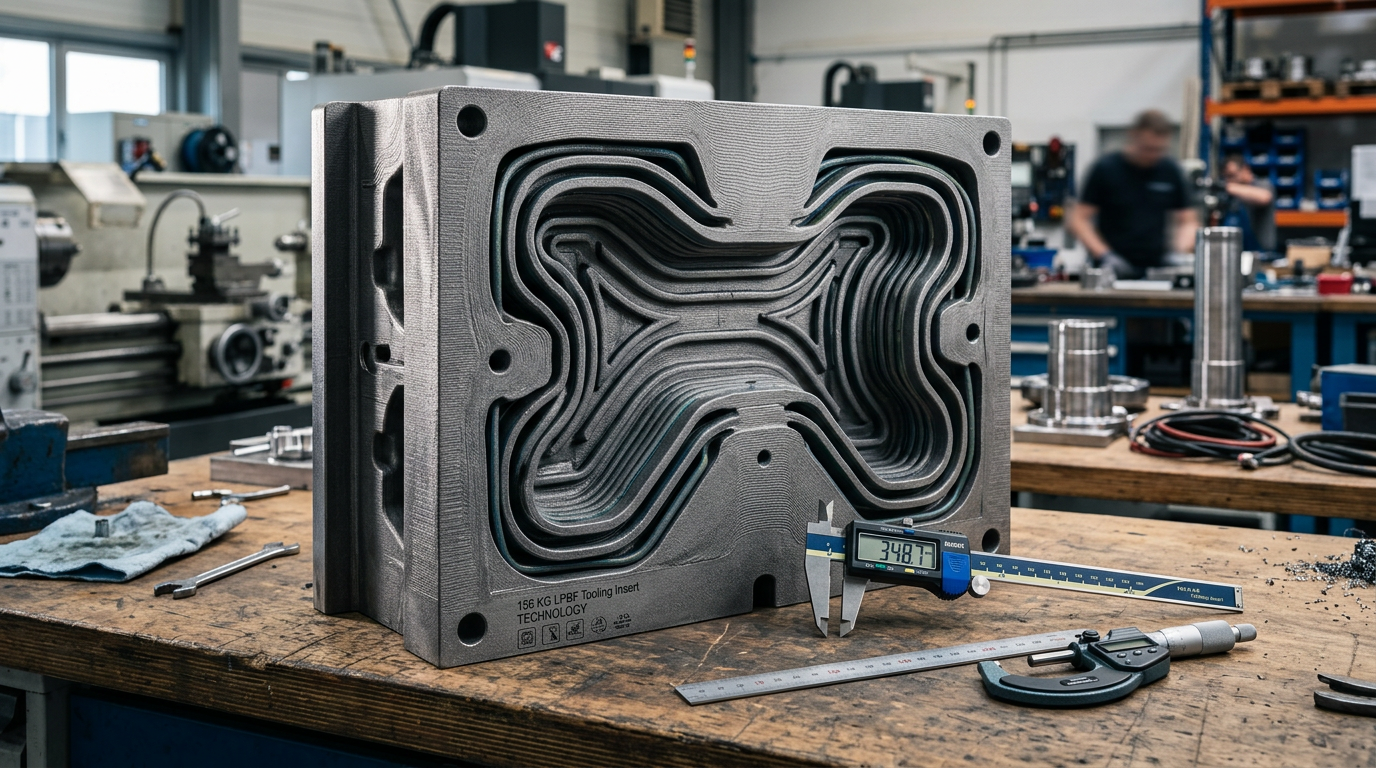
A landmark achievement in manufacturing innovation has just been announced: MacLean-Fogg Company and Fraunhofer ILT have successfully created and delivered the world's largest 3D-printed nearly solid die casting tooling insert to Toyota Europe. This 156 kg (350 lbs) insert, destined for Toyota's Yaris hybrid transmission housing production, represents a quantum leap in additive manufacturing scale and capability.
This breakthrough demonstrates that 3D-printed die casting tools are no longer experimental prototypes or small test parts. The insert is production-ready, capable of handling the rigorous demands of high-volume automotive manufacturing. For die casters and tooling manufacturers watching the additive revolution, this milestone answers a critical question: can AM-produced tooling truly replace traditional methods at scale?
The answer, according to the industry leaders behind this project, is a resounding yes, at least for specific applications where the advantages of 3D printing outweigh the investment and processing requirements.
How It Works: Laser Powder Bed Fusion at Scale
Creating a 156 kg die casting insert requires industrial-scale additive manufacturing equipment and expertise. MacLean-Fogg and Fraunhofer ILT employed a gantry-type, five-laser Laser Powder Bed Fusion (LPBF) system to produce this massive part.
Technical Specifications
- System: Five-laser gantry-type Laser Powder Bed Fusion machine
- Maximum printable dimension: Parts longer than 50 cm on each side
- Chamber temperature: Up to 200 degrees Celsius during printing
- Maximum volume capacity: Over 20,000 cm3 reproducibly
- Material: MacLean-Fogg's patented L-40 tool steel powder
LPBF works by spreading a thin layer of metal powder across a build platform, then using a high-powered laser (or in this case, five lasers) to melt and fuse the powder together according to the digital design. The platform lowers, another layer of powder is applied, and the process repeats. For a part of this size, the printing process itself takes considerable time, but the precision and complexity achievable are unmatched by conventional subtractive manufacturing methods.
The patented L-40 tool steel powder developed specifically for this application by MacLean-Fogg provides the strength, hardness, and thermal properties necessary to withstand the extreme conditions inside a die casting mold: temperatures, pressures, and thermal cycling that would rapidly degrade traditional tooling.
The Conformal Cooling Advantage
If larger size is the headline, conformal cooling is the real game-changer. This is where 3D-printed tooling truly shines.
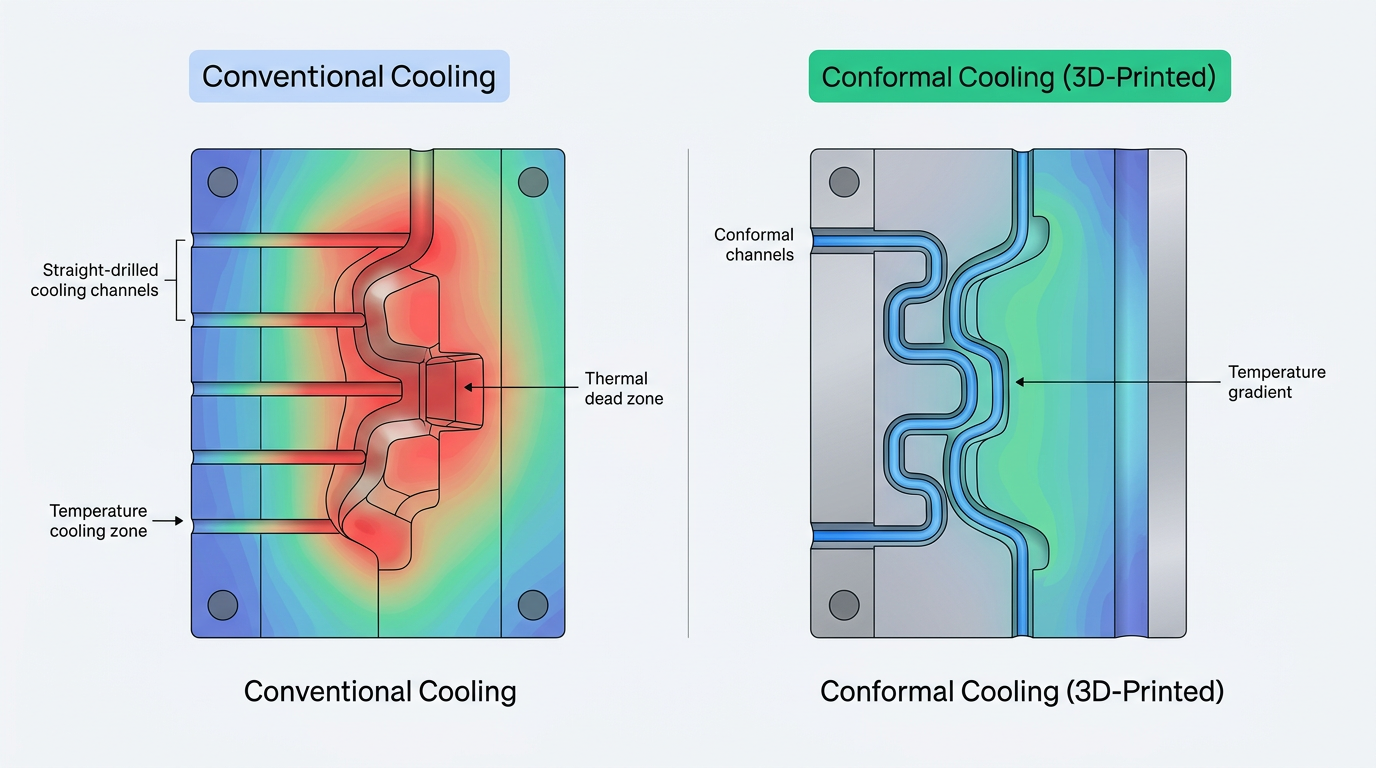
- Design: Straight, perpendicular channels drilled through mold
- Geometry: Limited by drilling constraints
- Efficiency: Uneven cooling across part surface
- Hotspots: Thermal peaks at distant locations
- Lifespan: Standard baseline
- Design: Channels follow exact contours of part geometry
- Geometry: Unlimited by manufacturing constraints
- Efficiency: Uniform cooling across all surfaces
- Hotspots: Eliminated through optimized channel placement
- Lifespan: 2x longer than conventional aluminum inserts
Conventional die casting molds use cooling channels drilled perpendicular to the mold surface. This is a logical geometric constraint when your manufacturing method is machining. But these straight channels often leave thermal dead zones. Certain areas of the mold heat up faster than others, creating uneven cooling that accelerates wear and limits tool life.
With 3D-printed conformal cooling, the cooling channels can be designed to follow the exact contours of the casting geometry itself. Instead of straight lines, imagine channels that curve and wind around complex shapes, always staying as close as possible to the surfaces that need cooling. This dramatically reduces local temperature peaks and distributes thermal stress evenly.
The result? The 3D-printed insert for Toyota's Yaris application has approximately 2x the lifespan of conventional aluminum die-casting inserts. In some cases, 3D-printed dies using optimized powders have lasted nearly 3x longer than traditional stainless steel dies.
For a manufacturer producing thousands of castings per day, extended tool life translates directly to lower per-unit tooling costs, less downtime for tool changes, and improved consistency across production runs.
Who's Behind It
This achievement is the result of collaboration between three key players, each bringing specialized expertise:
Fraunhofer ILT
Fraunhofer Institute for Laser Technology, Aachen, Germany. Leading European research institution specializing in laser technology and additive manufacturing. Developed and operates the five-laser LPBF system used for this project.
MacLean-Fogg
US-based manufacturer and technology leader in precision components. Developed the patented L-40 tool steel powder specifically formulated for additive manufacturing of die casting tooling.
Toyota Europe
End customer and production partner. Selected this advanced tooling solution for Yaris hybrid transmission housing manufacturing, validating the readiness of 3D-printed tools for high-volume automotive production.
The partnership between Fraunhofer's research capabilities and manufacturing expertise, MacLean-Fogg's material science innovation, and Toyota's quality and production requirements demonstrates the ecosystem that's driving this transformation forward.
What This Means for Die Casting Tooling
The implications of this breakthrough extend far beyond this single insert. Several significant shifts in the die casting industry are now accelerating:
Shorter Development Cycles
Traditional die casting tooling requires months of design refinement, multiple machining operations, and extensive testing. 3D-printed tools can dramatically compress this timeline. With digital-first design and direct manufacturing from CAD, time-to-market for new vehicle platforms shrinks significantly.
Expanded Applications
While this project focused on transmission housing, the technology is poised to expand into structural die casting, inserts for giga-casting tools, and other large hot and cold forming applications. Low-pressure die casting (LPDC) tooling, in particular, stands to benefit from the cost and cycle-time advantages of additive manufacturing.
Cost and Time Savings
Early data suggests that additive manufacturing could reduce mold production cycles by as much as 70% for certain geometries. When combined with extended tool life from conformal cooling, the total cost-of-ownership becomes compelling, even accounting for the higher per-unit material and processing costs of AM.
Global Tooling Competition
As additive manufacturing capabilities expand, the geographic advantages that traditionally favored tooling hubs (China, India, Mexico) may shift. If a die caster can get a complex tool produced in-house or from nearby suppliers using LPBF, the economics of international tooling procurement change fundamentally.
Strategic Advice for Die Casters Considering AM Tooling
- Start with geometry analysis: Not all die casting shapes benefit equally from conformal cooling. Evaluate your current tool portfolio for candidates where thermal management is the limiting factor.
- Build material relationships: Powders like MacLean-Fogg's L-40 are purpose-built for die casting conditions. Partner with suppliers who understand your specific application requirements.
- Plan for post-processing: 3D-printed parts still require finishing, surface treatment, and testing. Budget for these operations in your timeline.
- Think total cost, not unit cost: Compare the full cost-of-ownership including tool life, downtime, and casting quality improvements, not just the per-unit manufacturing cost.
- Monitor the technology roadmap: System costs are decreasing, material options are expanding, and process speed is improving. This is a strategic technology to track closely.
Limitations and What's Next
The promise of 3D-printed die casting tooling is real, but significant challenges remain before this becomes the default method for all mold production:
Equipment Cost
A five-laser gantry LPBF system is a multi-million-dollar investment. Only the largest tooling companies, OEMs, and research institutions can currently justify such expenditure. As the market matures and machine builders introduce more affordable systems, this barrier will lower.
Limited Material Selection
While tool steel powders like L-40 are a major advance, the palette of materials suitable for die casting tooling remains narrow compared to the options available through conventional metallurgy. Ongoing R&D is expanding this toolkit, but it's still a limitation.
Post-Processing Requirements
3D-printed parts typically require support removal, surface finishing, heat treatment, and often Hard Facing or other surface modifications before they're production-ready. These secondary operations add cost and time that must be factored into overall project economics.
Not Yet Universal
Certain complex die geometries, particularly those with sharp internal corners or extreme draft angles, remain challenging to print reliably. The technology continues to evolve, but conventional machining is still the right choice for some applications.
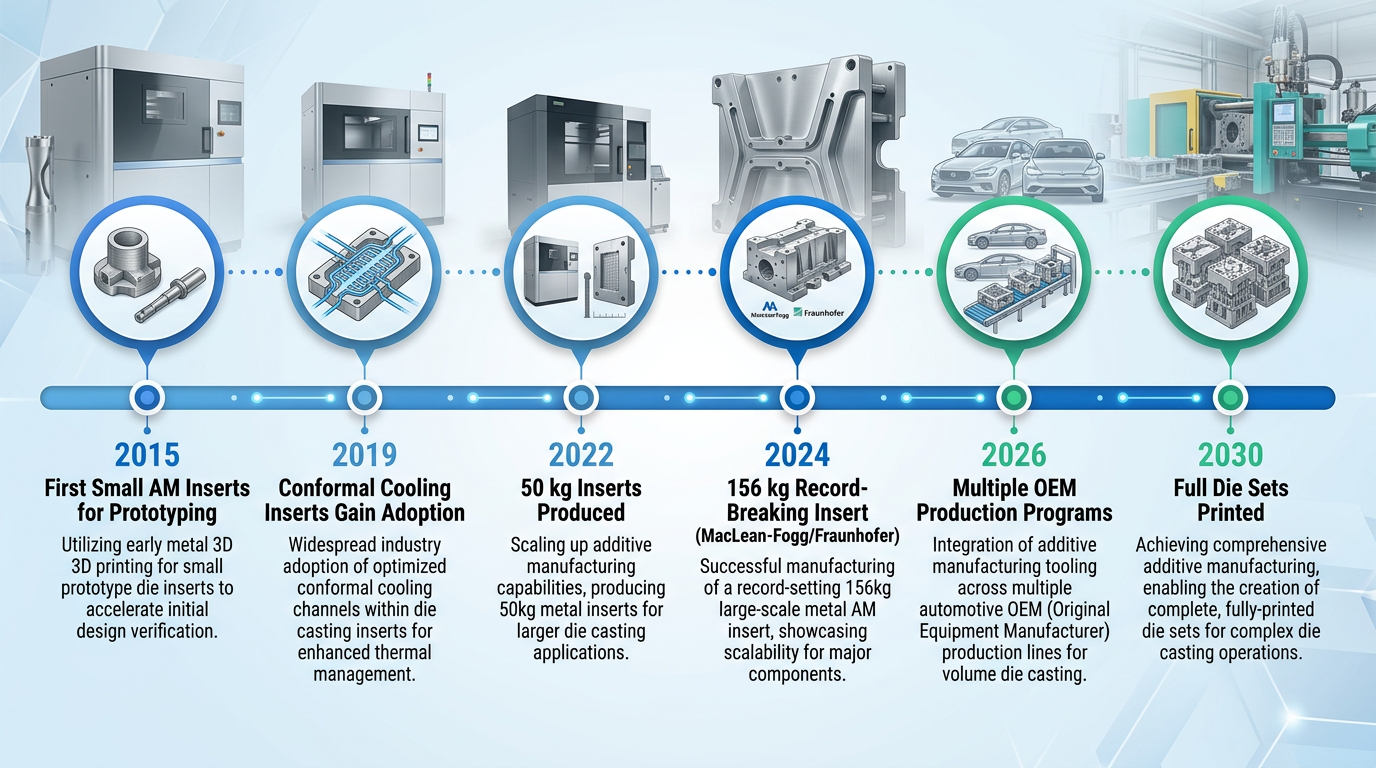
The trajectory, however, is clear. Equipment will become more accessible. Materials will improve. Post-processing will streamline. Within the next 3 to 5 years, expect to see 3D-printed tooling components integrated into a much broader range of die casting operations. They will not be a novelty, but a standard option in the tooling engineer's toolkit.