
What Is Giga-Casting?
Giga-casting, also called mega-casting, represents a fundamental shift in how automotive manufacturers approach structural assembly. Instead of stamping hundreds of individual parts and welding them together, OEMs now use massive die casting machines with clamping forces of 6,000 to 20,000 tons to cast entire vehicle structural sections in a single operation.
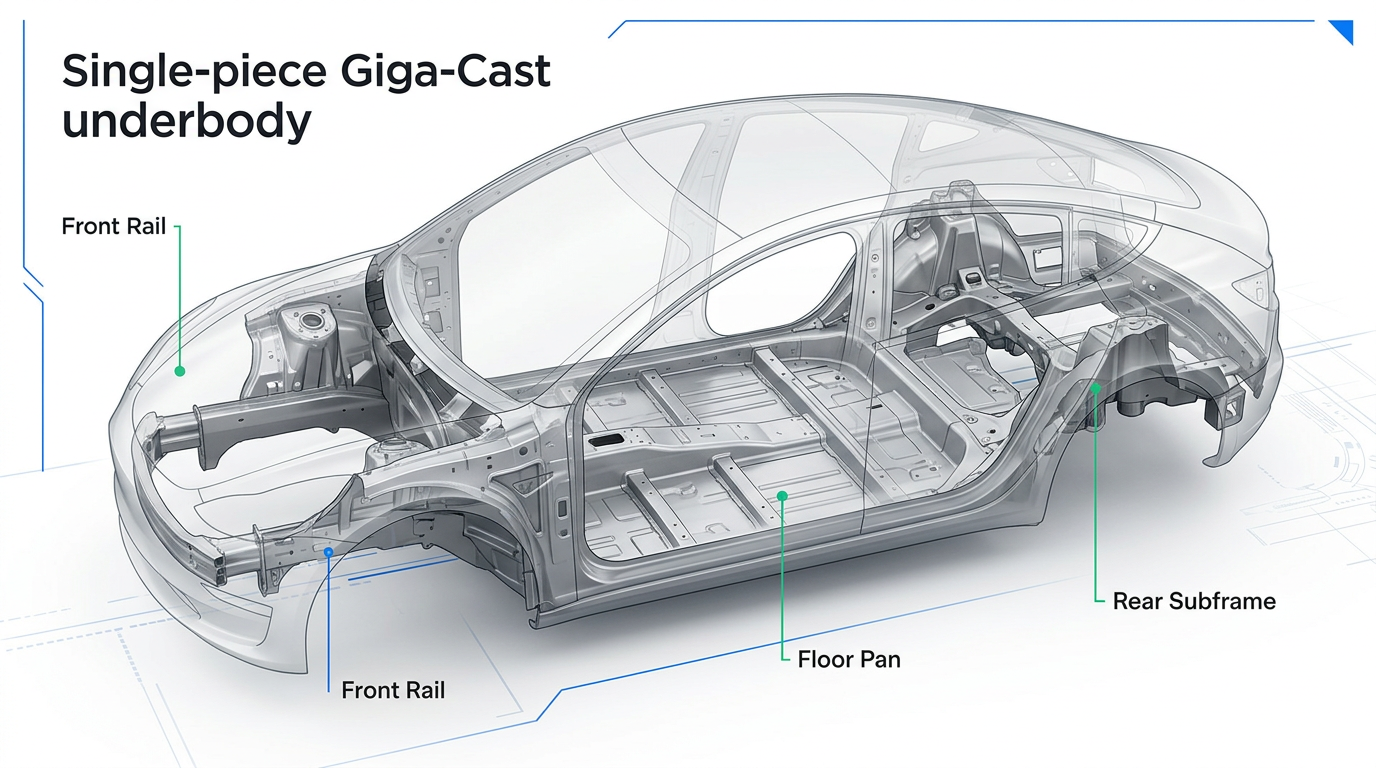
The core advantage is brutal simplicity: consolidation. Where traditional body-in-white assembly required 70 to 170+ stamped and welded parts, a giga-cast underbody assembly might be just 2 to 5 pieces. The Model Y rear underbody is the poster child. One casting replaces 70 separate stampings. This is not incremental improvement. It's a production paradigm shift.
The term 'giga-casting' is relatively new, coined around Tesla's pioneering adoption of IDRA's Giga Press technology starting in 2020. But the technology itself builds on decades of high-pressure die casting expertise. What changed is scale, investment commitment, and the willingness of major OEMs to redesign entire vehicle architectures around it.
For die casters, giga-casting represents both opportunity and existential pressure. The capital barriers are astronomical, but so are the rewards for manufacturers who can execute at scale.
Tesla's Lead: From Giga Press to Giga Press 4.0
Tesla did not invent giga-casting, but it did something equally important: it proved the concept works in high-volume EV production. Starting with the Model Y rear underbody in 2020, Tesla demonstrated that a single casting could replace 70 traditional stampings, reducing assembly time, weight, and cost.
The success was clear enough that Tesla rapidly iterated. The Giga Press technology evolved from initial 6,000-ton presses to newer generations with 17,000-ton clamping force: the Giga Press 4.0. This entered mass production in recent model years. These machines now produce complete rear floor assemblies for the Model Y in a single shot.
Key Stat: Tesla's single rear underbody casting replaces 70+ traditional stampings, reducing assembly steps by 80% and cutting manufacturing cost per unit by thousands of dollars in production volume.
Looking forward, Tesla is reportedly designing its $25,000 EV with an ambition that borders on revolutionary: cast the entire vehicle underbody as a single assembly. This would include the front frame, rear frame, and battery mid-section all in one piece. If achieved at scale, this could reduce EV manufacturing cost by 20-30% compared to traditional welded structures.
Gigafactory Texas is the showcase facility for this strategy. Tesla's commitment is not hypothetical; it's capital-intensive and already in execution.
Who Else Is Adopting?
Tesla's head start is real, but it's no longer alone. The adoption curve for giga-casting among major OEMs has shifted from 'early adopter' to 'essential capability.' At least nine major automakers have either committed to giga-casting for upcoming EV models or are actively implementing the technology.
Toyota
Committed to mega-casting for next-generation 2026 EV platforms. Toyota's conservative approach to manufacturing typically lags on adoption, but the economic case for giga-casting is too strong to ignore. Expected rollout across multiple EV models in the next 12-18 months.
Honda
Invested in six 6,100-ton giga-presses at its Anna Engine Plant in Ohio. This is Honda's concrete commitment to North American EV manufacturing. The Anna facility is expected to produce battery housings and structural components for Honda's EV lineup starting in late 2026.
BYD
The world's largest EV manufacturer by volume operates 8 integrated die casting bases across China with a combined annual capacity of 5 million units. BYD is using giga-casting across multiple platforms and is leveraging scale advantage to drive down costs faster than any competitor.
Volkswagen
VW's $3 billion investment in giga-casting infrastructure is the largest capital commitment in the industry. The company is developing 15,000-ton machines specifically for its 2026 EV model rollout. This is VW's attempt to compete on cost with BYD and Tesla.
Beyond these four heavyweights, Volvo (Polestar EVs), GAC Group (new facility starting January 2026 with 125,000-unit battery housing capacity), NIO (premium Chinese EV), Xpeng (smart EV manufacturer), and Li Auto (extended-range EV) have all announced giga-casting adoption or committed capital. The list grew from one (Tesla) to nine-plus in just five years.
The Equipment Race: 9,000 to 20,000 Tons
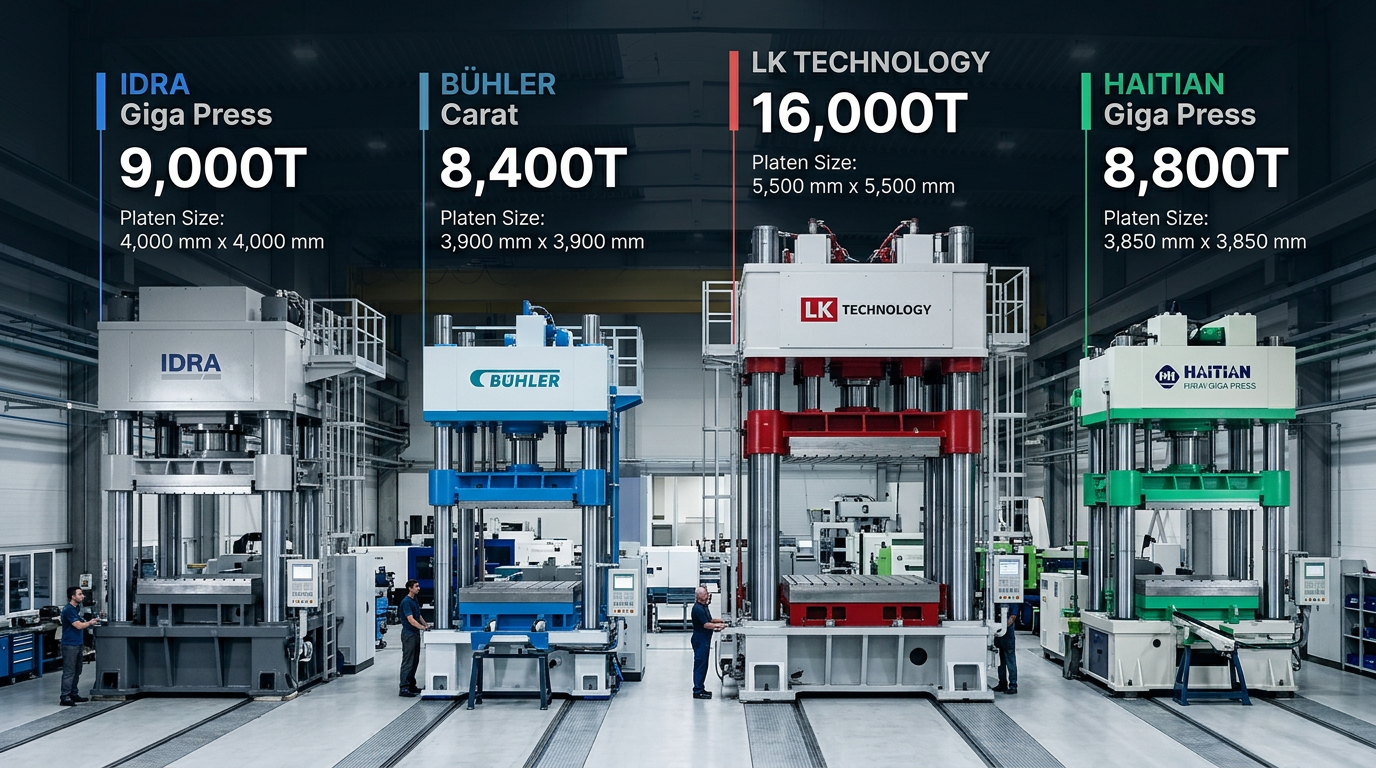
The scale of giga-casting machines is the most visible metric of the industry's evolution. The progression is staggering:
- 2020-2021: Initial Giga Press machines operate at 6,000-ton capacity
- 2022-2023: Second-generation machines achieve 9,000-ton and 12,000-ton capacity (with double injection)
- 2024-2025: Third-generation 16,000-ton machines now operate in production at multiple OEM facilities
- 2026+: 20,000-ton machines announced; represents 3.3x increase over original Giga Press
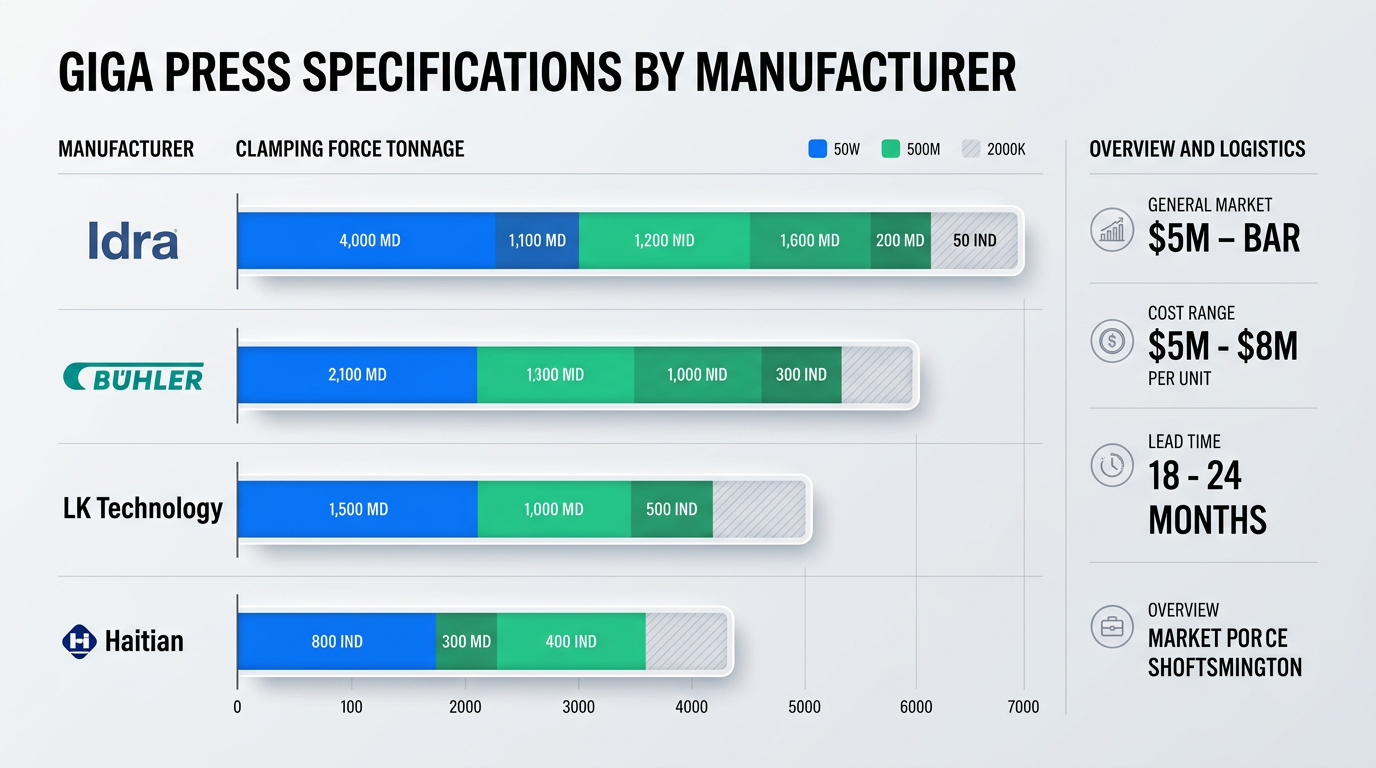
IDRA Group of Italy remains the market leader in giga-casting equipment, though LK Technology (China) and Buhler (Switzerland) are both competing for orders. A single giga press machine costs $5-8 million depending on capacity and customization. For a 16,000-ton press with full automation and process control, $8 million is realistic.
Equipment Investment Reality: A single giga-casting facility with two or three machines, full automation, and quality control systems represents a $20-30 million capital commitment for a mid-size die caster. This is a threshold most manufacturers cannot cross.
The equipment race is accelerating because larger presses mean higher part complexity can be cast in a single shot. A 20,000-ton machine can cast components that a 12,000-ton press cannot handle, opening new design possibilities for OEMs and expanding the addressable market for those who invest.
However, not every OEM needs 20,000-ton capacity. Toyota and Honda's investments focus on 6,000 to 9,000-ton machines optimized for battery housings and mid-body structures, not full underbodies. This suggests a bifurcated market where different capacity tiers serve different applications.
What This Means for Die Casters
Giga-casting is a consolidation play. Fewer parts means fewer suppliers. Fewer suppliers means fewer opportunities for the traditional die casting base to win business on structural automotive work. For most small and mid-market die casters, this is a wake-up call.
The capital barrier is the first filter. If you cannot invest $20-30 million in a giga-casting facility, you cannot compete for OEM structural business going forward. Most independent die casters operate on margins too thin to justify this level of capital deployment. This likely means consolidation among tier-1 suppliers and the exit of smaller competitors from this segment entirely.
But the market is not zero-sum. While structural casting opportunities shrink, secondary opportunities expand:
Opportunity Play: Smaller die casters should position for post-processing work on giga-cast parts: trimming, machining, finishing, assembly, and subassembly. The giga-cast underbody is rarely 100% finished when it leaves the press. It needs secondary operations, machining, and integration with other systems. These are high-volume, lower-margin operations that do not require a $20 million giga-casting investment.
Additionally, new alloy development specifically for mega-casting is an emerging opportunity. Giga-casting demands aluminum alloys with low iron content, high flowability, and superior heat transfer characteristics. Tier 2 and Tier 3 suppliers with metallurgical expertise can differentiate by developing and supplying specialized casting alloys optimized for giga-press parameters.
The strategic shift for traditional die casters is clear: move up the value chain from commodity casting to engineered solutions. Offer design optimization, alloy selection, prototype support, and post-processing capabilities. The suppliers who win will be those who reposition around value-add, not volume.
Challenges and Limitations
The giga-casting narrative is compelling, but it is not without friction. Several material, operational, and market challenges remain unsolved:
Repairability and Insurance Complexity: Thatcham Research, the UK's vehicle certification authority, released a critical analysis showing that while giga-cast underbodies reduce manufacturing cost, they increase repair complexity and insurance liability. A single crack in a cast underbody could require replacement of the entire assembly rather than repair of a welded section. Insurance companies and body shops are still grappling with pricing models for these scenarios.
Porosity Control at Scale: Casting large structural sections introduces porosity risks that are difficult to control. Cavitation, gas entrapment, and shrinkage defects become more critical in parts with higher structural loads. Automated quality detection at 16,000+ ton capacity remains a challenge. Even IDRA and Tesla have experienced quality escapes on giga-cast parts in production.
Tooling Cost and Lead Time: A single tool set for a giga-casting die can exceed $5 million in cost and require 12-18 months to design, build, and validate. This creates a massive barrier to design iteration and makes production run decisions largely irreversible. Any design change after tooling is locked becomes extraordinarily expensive.
Single-Point-of-Failure Risk: Consolidating 70+ parts into one casting creates a single point of failure. If the giga-casting press goes down, production stops immediately. There is no fallback supply chain, no buffer, no alternative. OEMs are now building redundancy into their gigafactories with multiple presses, but this increases capital and operational complexity.
Quality Control at Volume: Catching defects in a 100-pound aluminum casting is harder than catching defects in smaller components. Ultrasonic inspection, x-ray, and other NDT methods are slower and more expensive per unit. As production scales to thousands of units per day, quality control becomes the production bottleneck.