
1. Market Overview & Size
The permanent mold casting industry stands at an inflection point in 2026. With a market valuation of $5.2 billion in 2024, the sector is experiencing accelerated growth fueled by structural demand shifts in the automotive industry and increased emphasis on precision manufacturing. Industry analysts project the market to reach $8.7 billion by 2033, representing a compound annual growth rate of 6.0%—significantly outpacing general manufacturing growth.
This growth is not isolated to permanent mold casting alone. The broader aluminum casting market, which encompasses permanent mold, die casting, and sand casting processes, is valued at approximately $100.5 billion in 2026. Within this context, permanent mold casting represents a specialized but increasingly critical segment, particularly for applications where superior mechanical properties and dimensional precision are non-negotiable.
Market Growth Drivers
The permanent mold casting market is experiencing accelerated growth driven by EV platform adoption, supply chain localization, and stricter environmental regulations—creating a favorable structural environment for capacity expansion through 2033.
Several macroeconomic factors are driving this market expansion. First, the automotive industry's aggressive shift toward electric vehicles (EVs) and hybrid powertrains is creating new demand for lightweight components that maintain structural integrity. Second, the global supply chain restructuring following the 2020-2023 period has incentivized manufacturers to establish localized casting capabilities. Third, stricter environmental regulations in developed economies are encouraging the adoption of casting processes with lower energy consumption and material waste.
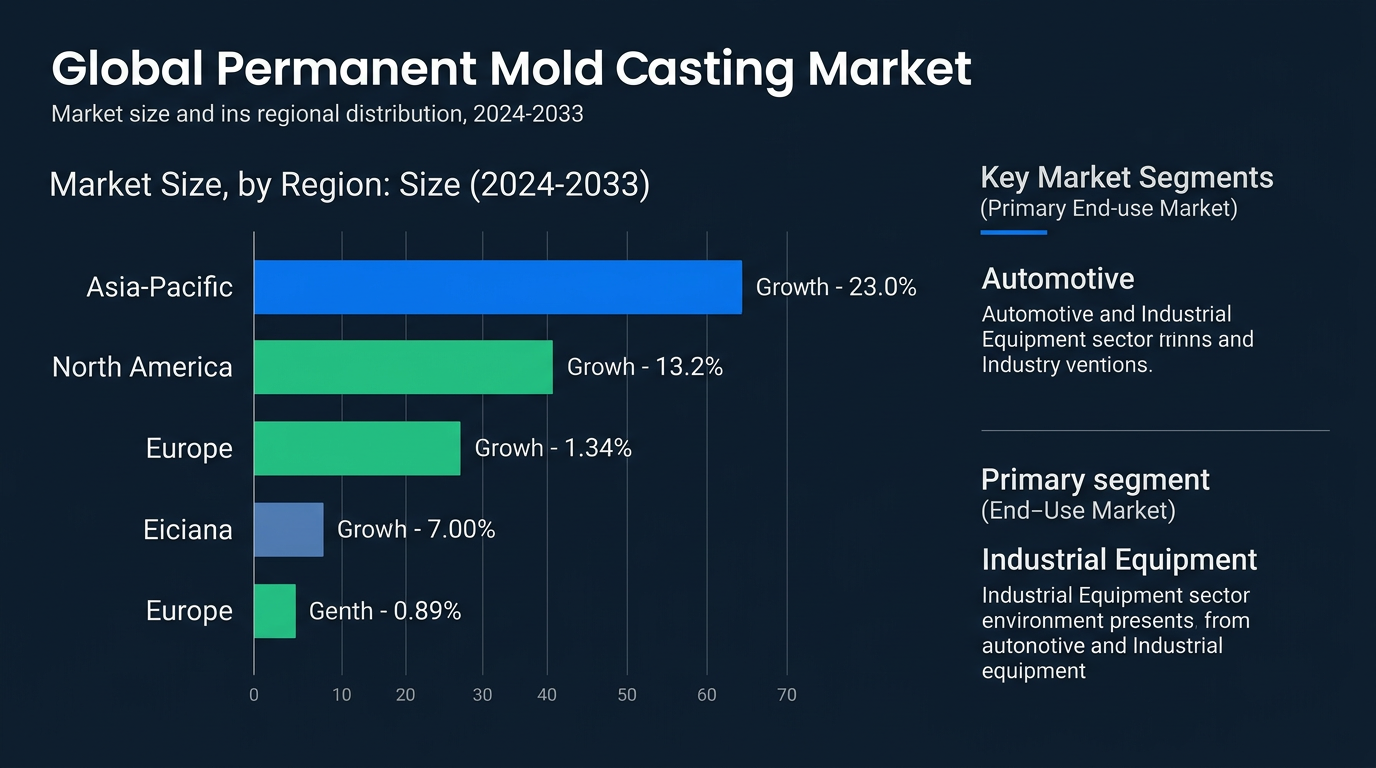
Geographic analysis reveals that North America and Europe continue to dominate the permanent mold casting market, driven by the presence of major automotive OEMs and their tier-1 suppliers. However, Asia-Pacific is emerging as the fastest-growing region, with China and India investing heavily in advanced manufacturing infrastructure to support both domestic automotive growth and export markets.
Strategic Positioning
Permanent mold casting occupies a unique market position. It bridges the gap between die casting (high-volume, lower cost, but limited mechanical properties) and sand casting (flexible, but higher per-unit costs and lower dimensional accuracy). Foundries that understand and market this positioning to precision-conscious buyers can command premium pricing while maintaining competitive advantages over both die-casting and sand-casting alternatives.
2. Automotive Lightweighting Drives Growth
The automotive industry's transition to electric vehicles represents the primary growth catalyst for permanent mold casting. OEMs across North America, Europe, and Asia are prioritizing vehicle lightweighting as a critical strategy to extend battery range, improve performance, and maintain competitive economics in the EV market where battery pack costs remain substantial.
Material Density Advantages
Aluminum and magnesium alloys used in permanent mold casting offer 60-70% density advantages compared to steel while maintaining critical safety-critical mechanical properties required for automotive structural and safety components.
EV Range Impact
In a typical electric sedan, the battery pack represents 25-30% of vehicle weight. Every kilogram saved in non-battery components directly improves vehicle efficiency and extends driving range—a critical competitive differentiator in EV markets.
Permanent mold casting enables automotive engineers to achieve weight reductions that would be impossible through traditional stamped steel or welded assembly methods. Aluminum and magnesium alloys, the materials of choice for permanent mold casting, offer density advantages of 60-70% compared to steel, while maintaining the mechanical properties required for safety-critical components. In a typical electric sedan, the battery pack represents 25-30% of vehicle weight; therefore, every kilogram saved in non-battery components directly improves the vehicle's effective energy efficiency and range.
Specific applications driving demand include:
- Engine blocks and transmission housings: Even in hybrid vehicles requiring both electric and conventional powertrains, permanent mold casting delivers superior thermal management and mechanical performance for internal combustion components.
- Structural components: Frame members, suspension brackets, and mounting structures cast from aluminum save significant weight without compromising structural rigidity.
- Thermal management systems: Permanent mold casting excels at creating complex cooling passages, critical for EV battery thermal management systems and power electronics cooling.
- Intake manifolds and fuel rails: These precision components require the dimensional accuracy and repeatability that only permanent mold casting provides reliably at scale.
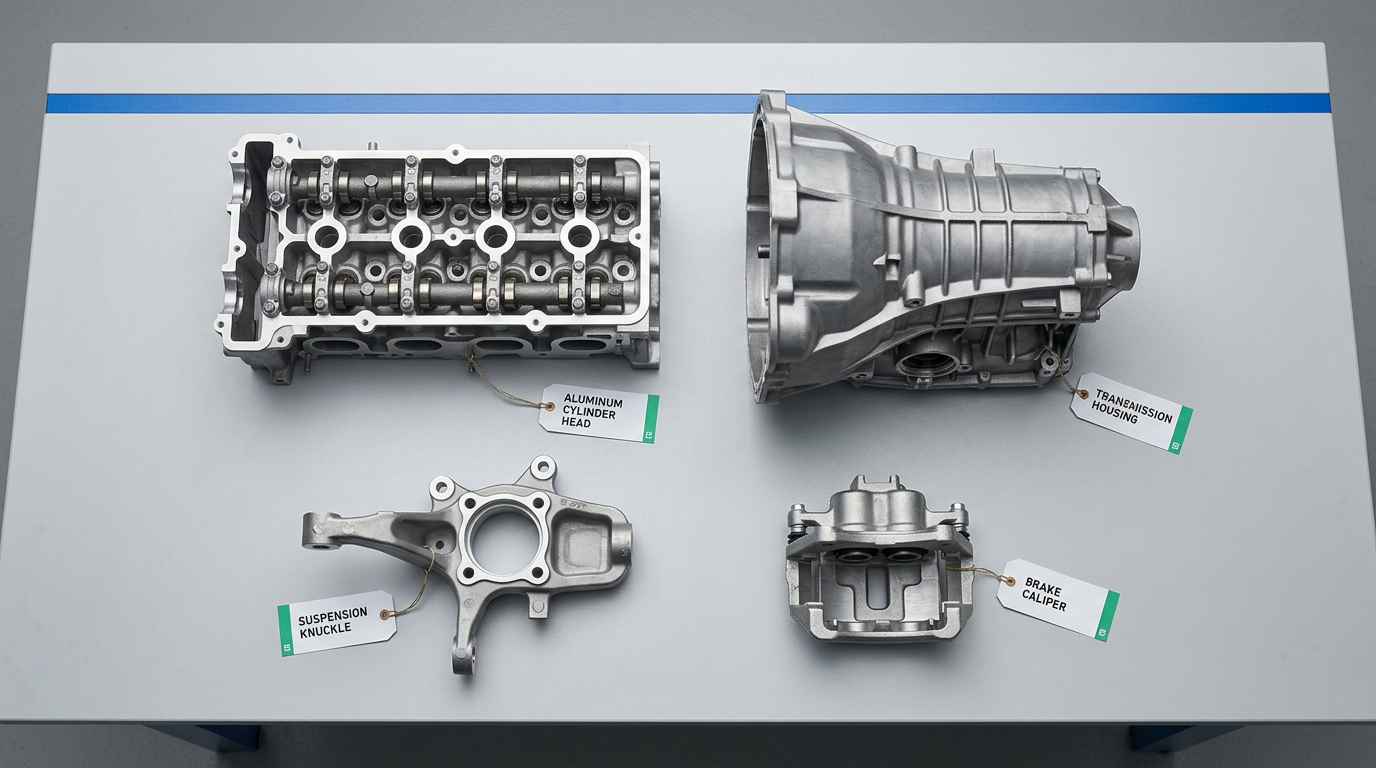
OEM tier-1 suppliers are responding to this demand by expanding permanent mold casting capacity. Major suppliers including Linamar Corporation, Nemak, GDL, and Martinrea have announced significant capital investments in new permanent mold casting facilities, targeting 2026-2028 completion timelines. These investments signal confidence in sustained demand for permanent mold castings through the remainder of this decade.
Economics of Consolidation
A permanent mold solution can reduce part count by 50-70%, eliminate secondary machining, and reduce assembly labor costs by 20-30%. Supply chain complexity drops dramatically when five parts consolidate into one casting—a major advantage for OEMs focused on resilience.
The economics are compelling. A permanent mold casting solution for an automotive component that previously required multiple stamped and welded operations can reduce part count by 50-70%, eliminate secondary machining operations, and reduce assembly labor costs by 20-30%. From a supply chain perspective, consolidating five parts into one permanent mold casting also dramatically reduces inventory complexity and supply chain risk—a consideration that resonates strongly with automotive purchasing departments focused on supply chain resilience.
3. Precision and Repeatability Advantages
In manufacturing, repeatability is as valuable as precision itself. Permanent mold casting delivers both attributes at a level that competing casting processes cannot match. The permanent steel mold, used repeatedly across hundreds of thousands of production cycles, creates an inherently stable production environment where casting-to-casting variation is minimal.
Dimensional Accuracy
Permanent mold casting achieves ±0.3% dimensional tolerance with surface roughness of 3.2-6.3 microns. This precision enables manufacturers to reduce or eliminate secondary machining, directly improving part costs and supply chain efficiency.
Quality Consistency Benefits
Superior grain structure results in higher tensile strength, improved ductility, and better fatigue resistance compared to die casting. This consistency enables long-term partnerships based on process-guaranteed quality rather than inspection-based sorting.
This repeatability manifests in several critical performance areas. Dimensional tolerance performance from permanent mold castings is typically ±0.3% of the casting dimension, with surface roughness in the 3.2-6.3 micron range. These metrics enable manufacturers to reduce or eliminate secondary machining operations that would be necessary with die casting (less precise) or sand casting (significantly less precise). When secondary machining is eliminated, part costs drop dramatically, and supply chain complexity decreases.
The mechanical properties of permanent mold castings also exceed those of competing processes. Due to slower cooling rates compared to die casting (but faster than sand casting), permanent mold castings develop superior grain structure, resulting in higher tensile strength, improved ductility, and better fatigue resistance. For automotive applications involving cyclic loading—such as suspension brackets, transmission housings, and engine blocks—these mechanical advantages are decisive factors in design engineer selection.
Supply Chain Resilience
When 99.2% of castings meet specifications without rework, production schedules become predictable, inventory requirements decrease, and delivery performance improves. This consistency creates compounding advantages through the entire supply chain.
Quality consistency enables permanent mold casting foundries to build long-term partnerships with precision-focused customers. Rather than requiring extensive incoming inspection and sorting, customers can rely on permanent mold castings arriving with predictable properties and dimensions. This shift from inspection-based quality to process-guaranteed quality represents a fundamental change in supply chain economics.
From a production planning perspective, permanent mold casting's repeatability also reduces the variability that creates supply chain disruptions. When 99.2% of castings meet specifications without rework, production schedules become more predictable, inventory requirements decrease, and customer delivery performance improves. These benefits cascade through the supply chain, creating compounding advantages for foundries that invest in optimized permanent mold technology and statistical process control systems.
4. Automated Casting Lines
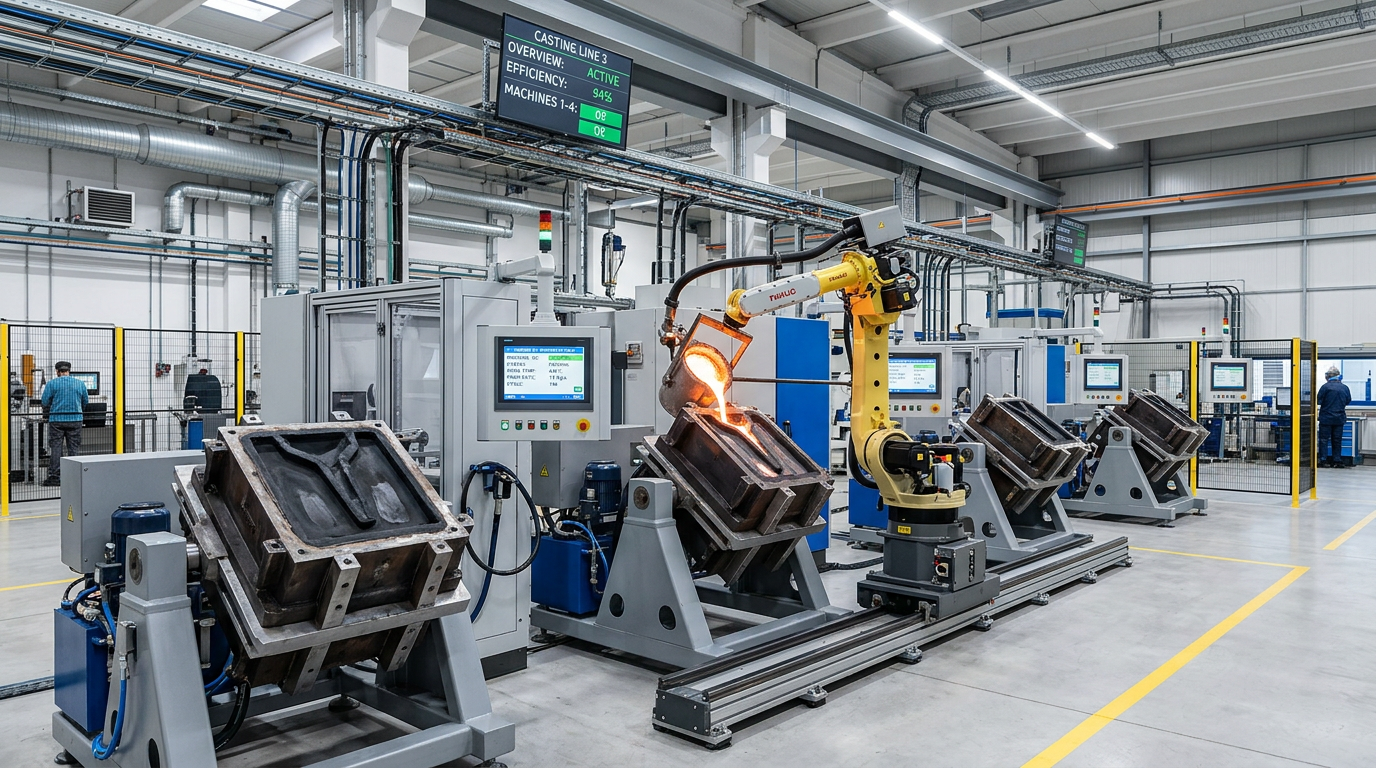
Automation in permanent mold casting is transitioning from aspirational to operational. By 2026, leading foundries across North America, Europe, and Asia have deployed or are deploying fully automated casting lines that integrate robotic mold handling, automated alloy dispensing, real-time temperature monitoring, and AI-driven quality control systems.
Productivity Gains
Modern automated lines operate at 1,200-1,800 shots per day versus 400-600 for semi-automated systems. This 3-4X productivity increase, combined with 35-50% labor cost reduction per casting, delivers significant competitive advantages in volume markets.
Quality & ROI
Automated systems improve quality metrics by 15-25% while the $3-5 million capital investment is recovered within 3-5 years for volume applications. This ROI justification makes automation increasingly mandatory for competitive foundries.
The business case for automation has become compelling. A modern automated permanent mold casting line can operate at 1,200-1,800 shots per day (compared to 400-600 for semi-automated systems), reduce labor costs per casting by 35-50%, and simultaneously improve quality metrics by 15-25%. The capital investment for a fully automated line ($3-5 million) is recovered within 3-5 years for volume applications, making automation economically justified for sustained-volume programs.
Beyond raw automation, smart casting technology is emerging as a competitive differentiator. These systems integrate:
- Real-time temperature monitoring: Embedded sensors track mold temperature, alloy temperature, and solidification rates, enabling dynamic process adjustment.
- Vision-based quality control: Machine vision systems inspect castings for surface defects, dimensional anomalies, and process deviations in real-time.
- Predictive maintenance: AI algorithms analyze process data to predict mold wear and maintenance requirements before failure occurs.
- Production optimization: Advanced scheduling algorithms optimize mold utilization, minimize changeover time, and maximize throughput.
- Traceability integration: Every casting is tagged with process parameters, enabling complete traceability and regulatory compliance documentation.
Market Share Gains from Technology Leadership
Foundries with fully automated, smart casting capabilities are experiencing order growth of 8-12% annually compared to 2-4% for traditional facilities. This capability gap is translating directly into competitive market share gains and premium pricing.
Foundries investing in these technologies are capturing tangible competitive advantages. A foundry with fully automated, smart casting capabilities can offer automotive OEMs guaranteed quality metrics, real-time production visibility, and supply chain predictability that semi-automated competitors cannot match. This capability difference is translating directly into market share gains, with advanced foundries experiencing order growth rates of 8-12% annually compared to 2-4% for traditional facilities.
The technology investment also addresses a critical challenge facing foundries worldwide: labor availability. With skilled foundry workers becoming increasingly difficult to recruit and retain, automation provides a pathway to maintain or expand production capacity despite labor market constraints. Automated facilities require fewer direct production workers, but demand more skilled technicians for equipment operation and maintenance—a skill profile that is proving easier to develop internally through training programs.
5. Competition from Die Casting and Sand Casting
While permanent mold casting is growing, it exists within a competitive ecosystem where die casting and sand casting processes continue to claim significant market share and are themselves evolving. Understanding the competitive dynamics is essential for foundries positioning their capabilities and customers evaluating manufacturing options.
Competitive Pressure Points
Die casting continues to improve in mechanical properties through advanced metallurgy and process innovations, potentially encroaching on permanent mold applications. Simultaneously, sand casting equipment and processes are becoming more automated and capable of producing more precise parts. Permanent mold foundries must continuously innovate and invest in advanced capabilities to defend market position against both competitors.
Casting Process Comparison
Advantages:
- Lowest per-unit cost at high volume
- Fastest cycle times (30-120 sec)
- Excellent dimensional accuracy
- Complex geometries possible
Limitations:
- Lower mechanical properties (porosity issues)
- Limited alloy compatibility
- High capital tooling cost
- Unsuitable for structural applications
Advantages:
- Superior mechanical properties
- Excellent repeatability
- Wider alloy compatibility
- Ideal for precision structural parts
Limitations:
- Higher per-unit cost vs die casting
- Longer cycle times (90-300 sec)
- Complex geometries more challenging
- Moderate tooling cost
Advantages:
- Lowest tooling cost
- Exceptional flexibility
- Can cast any alloy
- Best for prototypes/low volume
Limitations:
- Poorest dimensional accuracy
- High per-unit cost (labor intensive)
- Significant surface finish variation
- Extensive machining often required
vs. Die Casting
Permanent mold excels in applications requiring superior mechanical properties and fatigue resistance. Automotive structural components, brake systems, and suspension elements favor permanent mold despite cost premiums, where structural integrity is non-negotiable.
vs. Sand Casting
Permanent mold dominates in dimensional precision and repeatability. Economics favor permanent mold at 5,000-10,000+ annual units where tooling amortization and repeatability savings become significant competitive advantages.
The practical reality is that permanent mold casting faces distinct competitive pressures from each process in different market segments. Against die casting, permanent mold's competitive advantage is clearest in applications requiring superior mechanical properties, fatigue resistance, and where the cost penalty of lower per-unit pricing does not justify potential structural weaknesses. Automotive structural components, brake system components, and suspension elements fall squarely in permanent mold's competitive advantage zone.
Against sand casting, permanent mold's advantage is dimensional precision, repeatability, and reduced secondary machining. The economics favor permanent mold when production volumes exceed 5,000-10,000 units annually, as tooling costs are amortized and the repeatability savings become significant. For lower-volume applications, sand casting's flexibility and lower tooling cost remain superior alternatives.
Industry data indicates that the permanent mold segment is currently experiencing the strongest growth rate among all casting processes, suggesting that the competitive dynamics are currently tilted in permanent mold's favor. However, this growth is attracting competitive investment from both die-casting suppliers (developing higher-integrity die-casting alloys and processes) and sand-casting operations (automating sand operations). Permanent mold foundries must remain aggressive in technology investment to maintain competitive differentiation.
6. Regional Growth Patterns
The permanent mold casting market is experiencing distinctly different growth trajectories across geographic regions, reflecting varying automotive production trends, labor costs, environmental regulations, and supply chain strategies.
Regional Capacity Distribution
North America (28%), Europe (32%), and Asia-Pacific (30%) represent the three dominant regions. However, growth trajectories diverge significantly: North America 5-6% CAGR, Europe stable growth, Asia-Pacific fastest at 7-9% CAGR through 2033.
North America: The North American market remains mature with steady growth driven primarily by EV transition demand and increased lightweighting adoption. The United States and Mexico combined account for approximately 28% of global permanent mold casting capacity. Growth rates are moderate (5-6% CAGR) but characterized by high-value applications. North American foundries are driving automation investment and technology advancement, positioning themselves as premium suppliers to OEMs valuing quality and innovation over cost minimization.
Europe: European foundries face simultaneous tailwinds from automotive EV transition and headwinds from labor cost and energy expense pressures. The region accounts for approximately 32% of global capacity. Growth is driven by BMW, Mercedes-Benz, Volkswagen, and Audi's aggressive EV platforms, which incorporate significant lightweight castings. European foundries are responding by investing in automation and energy-efficient processes. The EU's carbon border adjustment mechanism is also driving foundries toward cleaner, more efficient processes where permanent mold casting is advantaged.
Asia-Pacific: This region is experiencing the most dynamic growth, with China, India, and Thailand emerging as major permanent mold casting hubs. Asia-Pacific currently represents 30% of global capacity but is expanding rapidly. Chinese automotive OEMs and suppliers are aggressively adopting permanent mold casting for EV platforms, while India is developing permanent mold capabilities to serve both domestic and export markets. Growth rates in Asia-Pacific are projected at 7-9% CAGR through 2033, driven by rising vehicle production volumes and increasing adoption of advanced casting technologies.
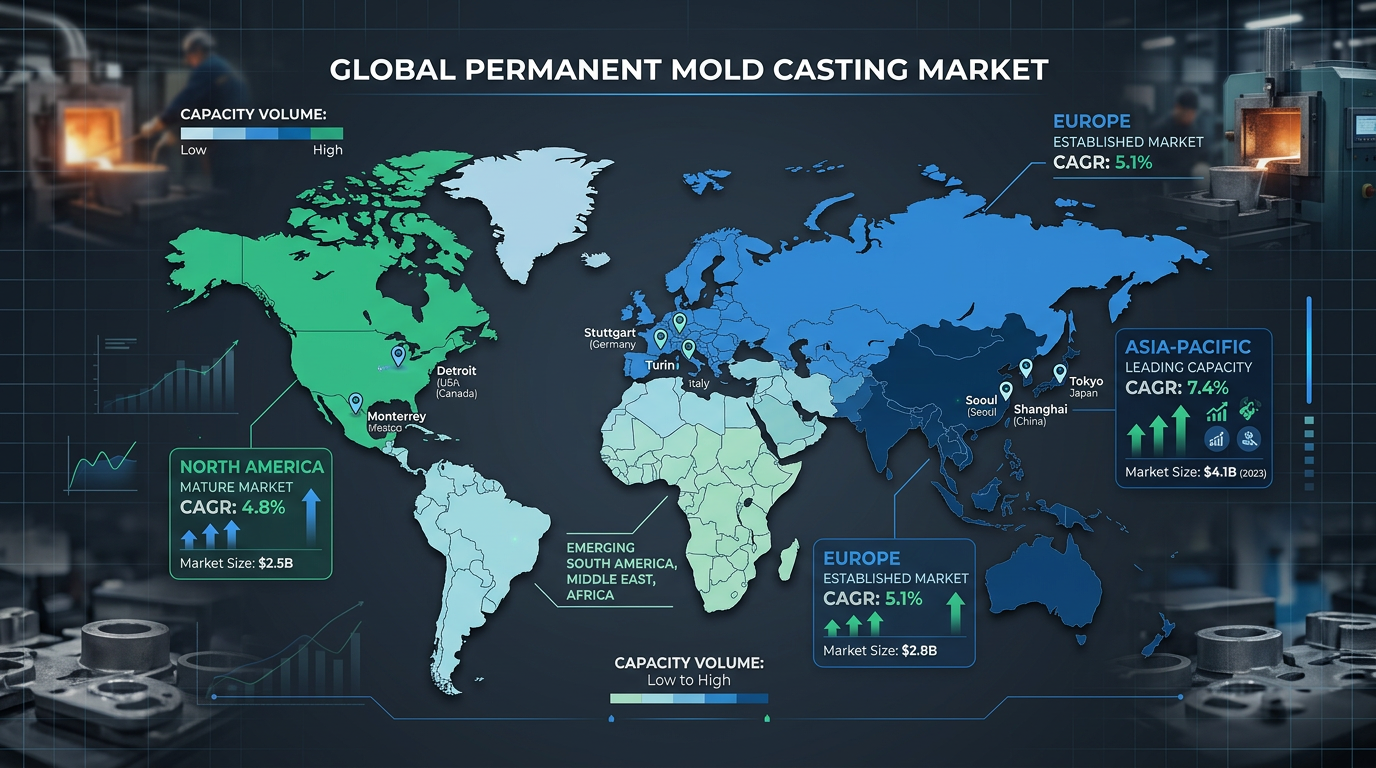
The geographic distribution is significant for customers of permanent mold casting services. Global OEMs are increasingly adopting regional sourcing strategies to reduce supply chain complexity and transportation costs. A North American automotive supplier may prefer permanent mold foundries located in North America or Mexico, while European OEMs prioritize European and Eastern European suppliers. This regionalization is creating opportunities for foundries serving local and regional markets while challenging those dependent on long-distance exports.
7. What This Means for Permanent Mold Foundries
For permanent mold foundries, the 2026 market landscape presents both significant opportunities and existential challenges. The fundamental dynamics are favorable—6% market growth, sustained automotive demand, and technology tailwinds supporting automation and efficiency improvements. However, realizing these opportunities requires strategic investments and operational excellence.
Technology Leadership
Automation, smart casting, and advanced quality systems enable disproportionate market share and 5-15% pricing premiums. Metrics that matter: faster turnaround, superior quality, advanced traceability, and reduced customer production risk.
Precision Specialization
Specialization in high-precision automotive structures, thermal management, and aerospace creates defensible competitive advantages against lower-cost regional competitors. Focus beats breadth in permanent mold casting.
Opportunity 1: Technology Leadership
Foundries that lead in automation, smart casting technology, and quality management systems are capturing disproportionate market share and commanding premium pricing. The competitive advantage is measured in real metrics: faster turnaround times, superior quality metrics, advanced traceability, and reduced customer production risk. Customers value these capabilities sufficiently to pay 5-15% premiums over competitors lacking them. For foundries with capital available for investment, technology advancement is a high-return opportunity.
Opportunity 2: Precision Specialization
A clear strategic opportunity exists for foundries to specialize in high-precision applications where permanent mold's advantages over die casting and sand casting are most defensible. Automotive structural components, thermal management systems, and aerospace components represent ideal focus areas. Foundries that invest in specialized capabilities, customer relationships, and quality systems for precision applications can defend against price competition from lower-cost regional competitors.
Opportunity 3: Supply Chain Partnerships
OEMs are increasingly seeking foundry partners capable of managing complex supply chain relationships, including multi-facility production networks, supply contingency planning, and real-time production visibility. Foundries positioned as supply chain partners—rather than transactional suppliers—capture premium pricing and more stable long-term contracts. This requires investments in ERP systems, supply chain software, and customer-facing digital platforms.
Challenge 1: Automation Capital Requirements
The capital requirements for competitive automation ($3-5 million per facility) are substantial, particularly for smaller regional foundries. Foundries unable to secure capital for technology investment risk competitive disadvantage as automated competitors gain cost, quality, and speed advantages. This is likely to drive consolidation, with larger regional or national foundries acquiring smaller competitors to achieve scale.
Challenge 2: Labor Market and Wage Inflation
Despite automation potential, foundries still require skilled technicians and process engineers. Wage inflation for skilled labor and difficulty recruiting production workers are ongoing challenges. Foundries must develop compelling employee value propositions, including career development opportunities and automation-resistant roles, to attract talent.
Challenge 3: Regulatory Compliance Complexity
Environmental regulations are tightening globally, with specific pressures on emissions, waste management, and energy efficiency. Foundries must invest in pollution control equipment, energy management systems, and waste reduction processes. The upfront capital costs are significant, but leading foundries are finding that environmental leadership becomes a competitive advantage with sustainability-focused OEMs and customers.
Strategic Recommendations:
- Assess Technology Position: Conduct honest assessment of current automation, quality systems, and digital capabilities compared to competitive benchmarks. Identify priority investment areas based on customer requirements and competitive threats.
- Define Market Focus: Rather than attempting to serve all customers, define specific market segments where permanent mold's advantages are most defensible and where your foundry can develop distinctive capabilities.
- Invest in Talent and Culture: Permanent mold casting's future depends on attracting and retaining technical talent. Invest in recruiting, training, and career development programs that create competitive advantage in tight labor markets.
- Build Customer Partnerships: Move beyond transactional supplier relationships to strategic partnerships where your foundry becomes deeply integrated into customer supply chain planning and problem-solving.
- Plan for Consolidation: Recognize that industry consolidation is likely, driven by capital requirements and scale economies. Prepare for this through strategic M&A or partnership positioning.