
1. Market Overview & Size
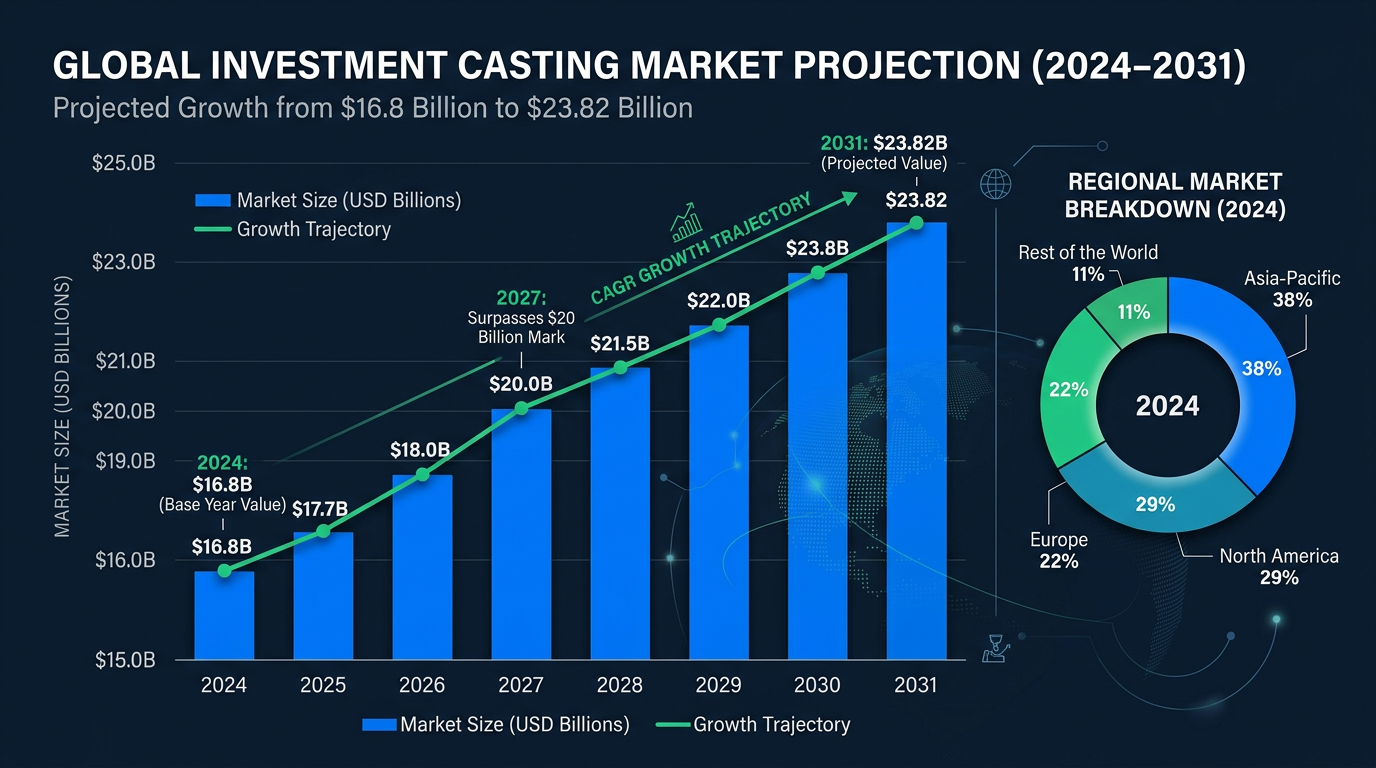
The global investment casting market stands at $18.45 billion in 2026, with projections reaching $23.82 billion by 2031. This represents a healthy compound annual growth rate of 5.25% over the five-year forecast period. The market's expansion reflects robust demand across multiple end-use industries, though aerospace and defense remain the primary growth engines.
Market Growth Trajectory
From $16.8 billion in 2024 to $23.82 billion by 2031, the investment casting industry is experiencing consistent growth averaging 5.25% annually. This expansion is driven by sustained aerospace recovery, escalating defense procurement, technological innovation, and supply chain diversification.
Investment casting's market resilience demonstrates the process's unique value proposition. Unlike higher-volume manufacturing processes constrained by tooling costs, investment casting serves the complex, precision-critical needs of industries where performance and reliability outweigh unit cost considerations. The COVID-19 pandemic caused temporary supply chain disruptions in 2022-2023, but recovery has been swift and steady, with manufacturers investing in capacity expansion and modernization throughout 2024-2025.
Market segmentation shows clear dominance by aerospace and defense, representing 45.6% of global revenue. The automotive sector contributes approximately 20% to 22% of market revenue, driven by turbocharger components, suspension parts, and other high-performance applications. Industrial machinery, medical devices, and power generation collectively comprise the remaining 30% to 35% of the market. Regional distribution sees North America and Europe accounting for approximately 60% of global investment casting market value, while Asia-Pacific is the fastest-growing region at 6.8% CAGR.
Regional Opportunity
While North America and Europe command 60% of global market value, Asia-Pacific represents the fastest-growing opportunity at 6.8% CAGR. India's emergence as a casting hub and China's aircraft industry expansion create significant growth potential for suppliers positioned in high-growth markets.
Market Drivers
Aerospace recovery, defense spending increases, technology adoption, and supply chain diversification are primary growth factors. Original equipment manufacturers (OEMs) continue investing in advanced casting capabilities to meet escalating performance demands.
Investment Outlook
Foundries benefit from sustained demand, capacity constraints creating pricing power, and technology integration opportunities. Strategic investments in automation, quality systems, and skilled talent development position industry leaders for strong competitive positioning.
2. Aerospace Recovery Drives Demand
The global commercial aerospace sector is experiencing sustained recovery and expansion following pandemic-induced disruptions. Commercial aircraft deliveries reached historical highs in 2025, with Boeing and Airbus collectively delivering over 1,400 aircraft. This recovery translates directly into increased demand for investment castings across multiple aircraft subsystems.
Commercial Fleet Expansion
From 28,400 aircraft in 2024 to 36,400 by 2034, a 28% increase in the global commercial aircraft fleet creates sustained multi-decade demand for investment castings. Each new aircraft requires 500-2,000+ cast components across engines, landing gear, hydraulic systems, and structural assemblies.
The global commercial aircraft fleet was approximately 28,400 aircraft in 2024. Industry forecasts project this fleet to grow to approximately 36,400 aircraft by 2034, representing a 28% increase over ten years. This expansion primarily reflects aircraft replacement in developing nations, growth in air travel demand, and regional aircraft expansion. Each new aircraft requires hundreds to thousands of investment-cast components, from turbine blades and engine casings to landing gear assemblies and structural brackets.
Investment casting is particularly critical in aircraft engines, where turbine blades and vanes must withstand temperatures exceeding 1,700 degrees Fahrenheit while maintaining structural integrity and aerodynamic precision. Modern turbine blade casting advances include directional solidification and single-crystal casting techniques that produce components impossible to achieve through conventional machining. Engine manufacturers maintain 15-to-20-year development cycles for new engines, with multiple investment casting suppliers qualifying for volume production over the engine's lifetime.
Directional Solidification
- Temperature capability: Up to 1,800F sustained
- Application: Intermediate turbine stages
- Advantage: Grain alignment improves creep resistance
- Cost: Moderate to high
- Volume: Thousands per program annually
Single-Crystal Casting
- Temperature capability: 1,900F+ sustained
- Application: High-pressure turbine stages
- Advantage: Superior high-temperature strength
- Cost: Premium pricing
- Volume: Critical path component
Beyond engines, investment casting produces landing gear components, hydraulic valve bodies, actuator housings, and structural fasteners. The trend toward increased aircraft efficiency and weight reduction drives adoption of advanced materials and tighter tolerances, both favoring investment casting capabilities. Composite aircraft fuselages paired with enhanced cast metal systems create high-performance, fuel-efficient aircraft meeting environmental and operational requirements.
Market insight
Aircraft programs like the Boeing 787 and Airbus A350 leverage advanced composite materials but still require hundreds of investment-cast metal components for engines, landing gear, and structural systems. Each aircraft program generates decades of sustained demand for casting suppliers capable of meeting aerospace quality and performance standards.
3. Defense Spending and Its Impact
Global defense spending reached $2.44 trillion in 2024, with continued increases projected through 2026 and beyond. The United States leads defense spending at approximately $850 billion annually, followed by China at $296 billion and Russia at $109 billion. These defense budgets fund aircraft programs, missile systems, naval vessels, and ground combat platforms all requiring investment-cast components.
F-35 Program Scale
Production rates exceeding 150 aircraft annually across multiple nations. Each F-35 contains thousands of investment-cast components. Procurement plans extend through 2035+, creating sustained multi-decade demand for aerospace-grade castings across superalloy turbines, structural components, and landing gear assemblies.
Advanced fighter aircraft programs like the F-35 Lightning II drive substantial demand for superalloy castings. Each F-35 aircraft contains thousands of cast components across airframe structures, landing gear, hydraulic systems, and avionics housings. Production rates have exceeded 150 aircraft per year globally, with supplier networks spanning multiple countries. Current procurement plans extend through 2035 and potentially beyond, creating multi-decade revenue streams for qualified investment casters.
Unmanned systems represent a growing segment within defense spending, with drone programs expanding globally. Unmanned aerial vehicles (UAVs) require miniaturized, lightweight investment-cast components for flight control systems, payload mounting structures, and propulsion systems. Both fixed-wing and rotary-wing drones create demand for precision castings in advanced alloys meeting military performance specifications.
Naval shipbuilding programs continue expansion with new frigate, destroyer, and aircraft carrier projects across multiple nations. These platforms incorporate investment-cast components in propulsion systems, steering mechanisms, weapons mounts, and structural assemblies. Additionally, missile defense systems, including air defense radars and launch systems, utilize investment-cast aluminum and steel components manufactured to exacting specifications.
Capacity considerations
The combination of aerospace and defense demand growth is creating capacity constraints among established investment casting foundries. Skilled labor shortages, particularly in ceramic shell building and quality control positions, limit production expansion. Foundries investing in workforce development, modern equipment, and automation are positioning themselves for strong competitive advantage as demand continues escalating.
4. Additive Manufacturing Meets Investment Casting
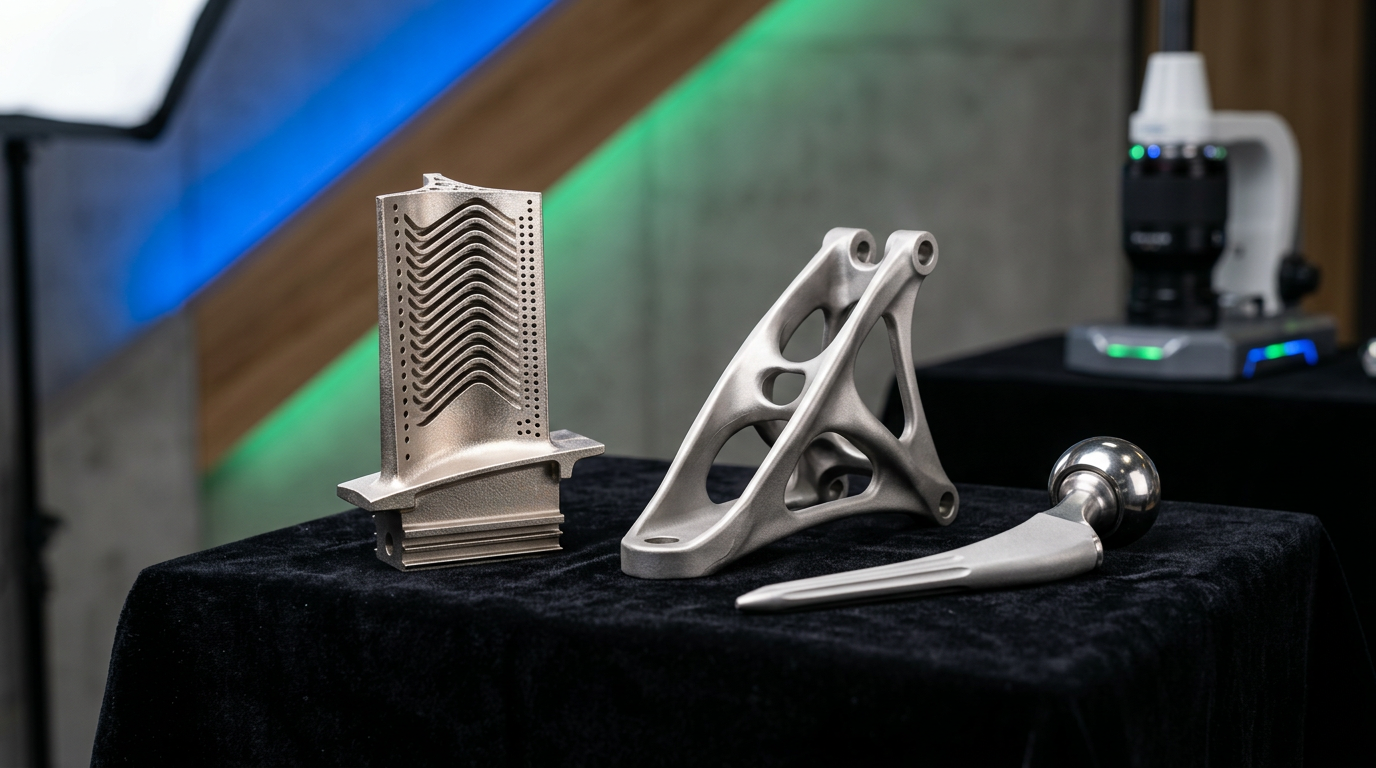
The convergence of additive manufacturing (3D printing) and investment casting represents the industry's most transformative technological development of the 2020s. Rather than competing technologies, 3D printing has become an enabling technology for investment casting, revolutionizing pattern creation, mold manufacturing, and prototype development.
Traditional investment casting begins with wax pattern injection into a metal die cavity. Die fabrication costs range from $5,000 to $50,000 depending on part complexity and size, with manufacturing lead times of 8 to 12 weeks. Additive manufacturing eliminates this constraint by creating wax patterns directly from CAD data. 3D-printed wax patterns arrive production-ready in 3 to 5 days, with tooling costs under $1,000 for prototype quantities. This capability has democratized investment casting for small and medium enterprises previously unable to justify traditional tooling investments.
Beyond wax patterns, 3D printing technology creates ceramic shell molds, reducing shell-building labor and accelerating production cycles. Binder jet technology deposits ceramic material in layers, allowing complex internal structures impossible to hand-build. These printed shells reduce manufacturing time, improve dimensional consistency, and enable casting of previously impossible geometric configurations.
Design optimization benefits significantly from 3D printing integration. Engineers can iterate designs rapidly, printing test patterns within days rather than months. This acceleration shortens development timelines and enables more aggressive design optimization for weight reduction and performance enhancement. Hybrid casting approaches combining 3D-printed patterns with traditional ceramic shell techniques offer cost-effective production across volume ranges from single prototypes to 10,000+ piece annual production.
Investment foundries that have integrated additive manufacturing are capturing market share from competitors lacking this capability. The ability to rapidly prototype, iterate, and transition to low-cost production volume gives early adopters significant competitive advantage. Industry data shows 35% of investment casters had implemented 3D pattern printing by 2025, with 60% adoption projected by 2028.
Development acceleration
3D-printed wax patterns reduce investment casting development timelines from 8-12 weeks to 2-3 weeks. This capability enables rapid prototyping, accelerates design validation, and shortens time-to-market for new products. For aerospace programs managing multiple development phases, this acceleration translates to schedule advantages and cost savings through earlier problem identification and resolution.
Traditional Wax Pattern Tooling
- Lead time: 8-12 weeks
- Tooling cost: $5,000-$50,000
- Design changes: Requires retooling
- Minimum volume: 25-100 pieces
- Best for: Production runs 1,000+ annually
- Pattern accuracy: Excellent for high volumes
3D-Printed Pattern Process
- Lead time: 3-5 days
- Tooling cost: Under $1,000
- Design changes: Same-day iteration
- Minimum volume: 1 piece (prototype)
- Best for: Prototypes and low volumes
- Pattern flexibility: Excellent for complex geometries
5. Material Innovation: Superalloys and Beyond
Advanced material development remains central to aerospace and defense competitiveness, driving sustained investment in casting alloy research and development. Modern turbine engines operate at progressively higher temperatures, requiring materials that maintain strength at 1,700+ degrees Fahrenheit. Investment casting's capability to produce near-net-shape components in these advanced alloys creates enormous strategic value.
Temperature Progression in Turbine Design
Each new engine generation pushes turbine inlet temperatures 15-20 degrees higher through material innovation. Current state-of-the-art engines achieve 1,950F+ blade inlet temperatures. Advanced single-crystal casting techniques and composition refinements continue enabling higher operating temperatures, providing competitive advantage through improved efficiency and performance.
Nickel-base superalloys including Inconel 713C, Inconel 792, PWA 1484, and CMSX-4 dominate high-temperature applications. These materials undergo continuous refinement to improve creep resistance, fatigue strength, and oxidation resistance. Directional solidification and single-crystal casting techniques push performance boundaries, enabling turbine blade inlet temperatures above 1,950 degrees Fahrenheit. Each new engine generation relies on incremental material improvements supporting 15- to 20-degree temperature increases.
Nickel-Base Superalloys
- Examples: Inconel 713C, PWA 1484, CMSX-4
- Temperature: 1,700-1,950F sustained
- Strength: Excellent creep resistance
- Application: High-pressure turbine blades
- Market share: 70%+ of turbine castings
Advanced Lightweight Alloys
- Examples: Aluminum-lithium, titanium aluminides
- Weight advantage: 15-20% lighter than aluminum
- Strength: Comparable to titanium
- Application: Aircraft structures, landing gear
- Growth rate: 8-12% annually
Cobalt-chrome superalloys serve specific applications where nickel-base materials become brittle. These alloys excel in rotating components requiring high fatigue strength and wear resistance. Medical device manufacturers prefer cobalt-chrome for implants and surgical instruments where biocompatibility and durability are paramount. Aerospace applications include blades in lower-temperature engine stages where cobalt-chrome outperforms nickel alloys.
Aluminum-lithium alloys represent the frontier in lightweight casting materials. These alloys achieve strength-to-weight ratios approaching titanium while maintaining aluminum's casting processability. Aircraft primary structures increasingly incorporate aluminum-lithium components, reducing weight and improving fuel efficiency. Investment casting enables production of complex aluminum-lithium structures impossible to machine from solid stock.
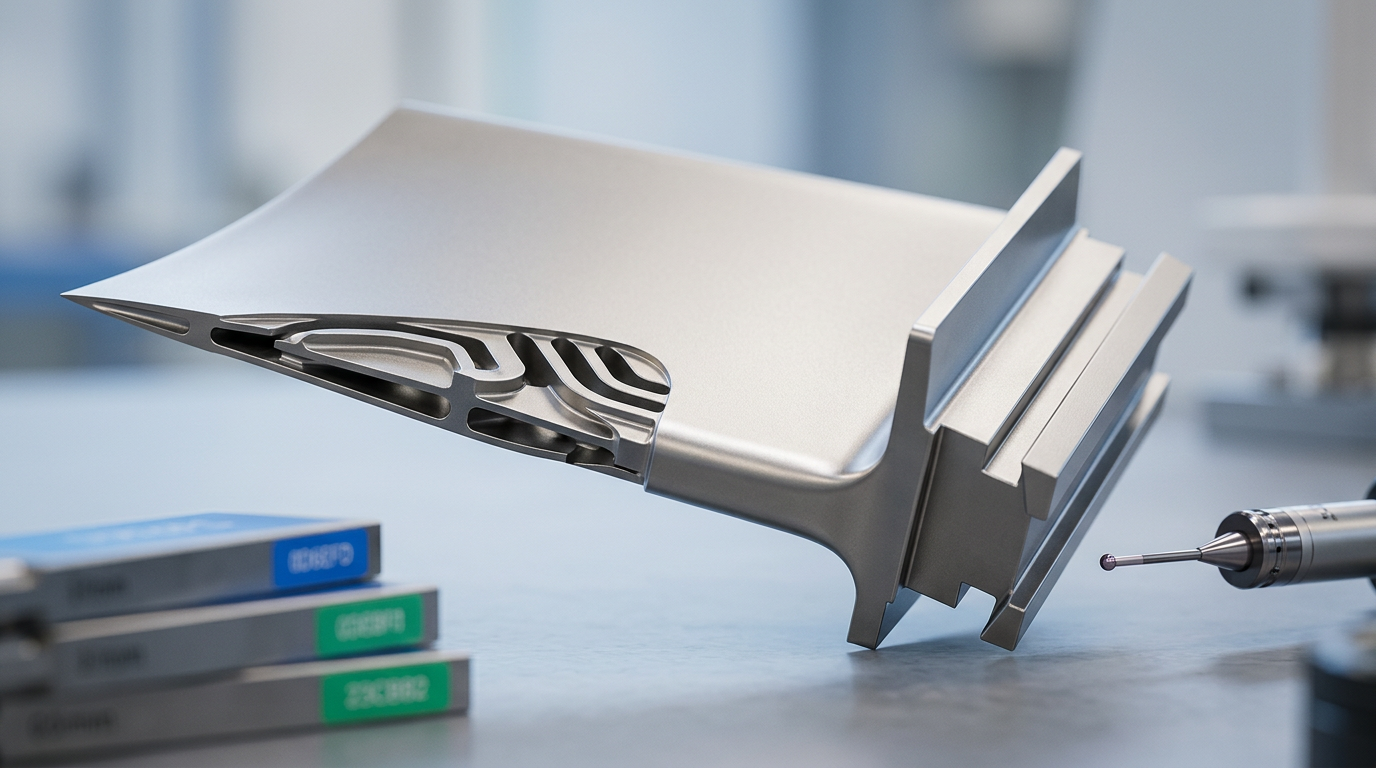
Shell-building advances complement material improvements. Silica-sol shells provide superior surface finish, dimensional accuracy, and thermal conductivity compared to traditional fused-silica shells. Hybrid ceramic systems combining silica-sol cores with zirconia backups offer enhanced refractory properties for superalloy casting. These shell innovations reduce surface defects, improve casting quality, and enable tighter tolerance compliance.
Traditional Fused-Silica Shells
- Composition: Quartz sand, binders
- Surface finish: Good, some cleanup required
- Dimensional accuracy: +/- 0.015" typical
- Cost: Baseline reference
- Application: Standard aerospace and industrial
Advanced Silica-Sol & Hybrid Systems
- Composition: Silica-sol colloidal suspension + zirconia
- Surface finish: Excellent, minimal finishing
- Dimensional accuracy: +/- 0.010" or tighter
- Cost: 10-15% premium
- Application: Precision superalloy turbines
6. Regional Market Dynamics
Investment casting markets exhibit distinct regional characteristics reflecting manufacturing competitiveness, labor economics, technology adoption, and proximity to end-use industries.
North America
Represents 35% of global investment casting market value. Dominated by aerospace manufacturers (Boeing, Lockheed Martin, Raytheon) and engines (Pratt & Whitney, General Electric). U.S. foundries benefit from geographic proximity to OEMs, skilled workforce availability, and established quality systems. Recent reshoring initiatives strengthen regional competitiveness.
Capacity: Exceeds 85% utilization, supporting price realization and margin expansion.
Europe
Accounts for 25% of global market value. Germany leads European casting production, supported by Siemens industrial base and automotive suppliers (Mercedes, BMW, Porsche). Italy and Spain maintain significant aerospace casting capabilities serving Airbus and tier-one suppliers. French and British foundries specialize in superalloy precision castings.
Challenge: Higher labor costs drive automation and technology adoption investments.
Asia-Pacific: Fastest-Growing Region
Fastest-growing region at 6.8% CAGR, growing from 25% to projected 30% market share by 2031. India has emerged as a major investment casting hub, with foundries supplying aerospace OEMs and capturing automotive business from established suppliers. China's aircraft industry expansion (Comac C919 program) drives domestic casting demand. Japan maintains premium market position in precision superalloy castings. Southeast Asia develops emerging capabilities targeting regional aircraft programs and automotive growth.
7. What This Means for Investment Casting Foundries
The 2026 investment casting market environment presents both extraordinary opportunities and significant challenges for foundry operators. Sustained demand growth creates capacity constraints that support pricing power, yet foundries must execute strategic investments to capitalize on these opportunities.
Capacity Planning
Capacity utilization above 85% across major markets indicates supply tightness. Foundries operating at 90%+ utilization lack flexibility for growth without capital investment.
Timeline: 18-24 months for strategic capacity additions. Equipment lead times exceed 12 months.
Technology Integration
Additive manufacturing adoption is no longer optional for competitive positioning. Foundries without 3D printing capabilities lose prototyping and low-volume business.
Investment: $500K-$2M+ depending on sophistication. Implementation: 2-3 years.
Workforce Development
Skilled labor shortages represent the industry's most immediate constraint. Ceramic shell builders and pattern makers require 2-3 year apprenticeships.
Competitive advantage: Training programs and mentorship create sustainable labor stability.
Quality System Enhancement
Aerospace and defense increasingly demand AS9100D, ISO 9001:2015 with special process documentation and real-time traceability.
Benefit: Strengthens customer relationships and supports premium pricing.
Strategic Opportunities for Foundries
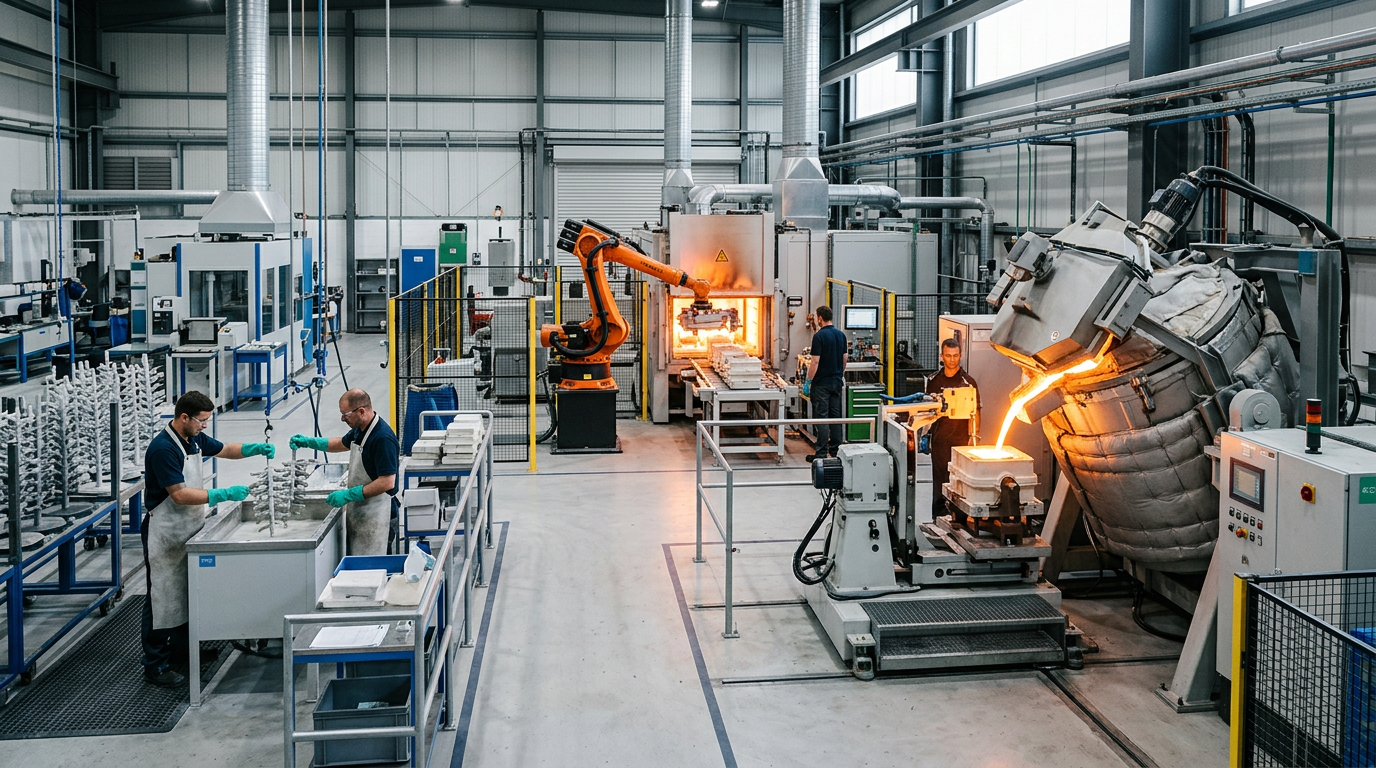
Well-positioned foundries demonstrate: advanced technology adoption (3D printing, automation), workforce development investment, strategic geographic positioning near OEM customers, specialized capabilities in superalloys and precision applications, and proactive quality system development exceeding customer expectations.
Key competitive advantages: capability depth in aerospace-grade materials, demonstrated quality performance, geographic proximity to major OEMs, technology integration readiness, and strong customer relationships providing demand visibility.
Consolidation trends continue reshaping the industry landscape. Larger foundries acquire smaller competitors to achieve scale advantages, technology capabilities, and customer portfolio diversification. Mid-size foundries maintaining distinct competitive advantages and strong customer relationships remain attractive acquisition targets. Independent foundries focusing on specialized niches (superalloys, precision components, medical devices) sustain viable business models serving global customer bases.
Margin Sustainability 2026-2027
Strong demand, capacity constraints, and customer quality requirements support margin expansion through 2027. Foundries must balance pricing power with customer relationship management.
- Long-term supply agreements provide demand certainty
- Annual escalation clauses limit pricing flexibility
Strategic Mix Management
Balancing high-margin aerospace and defense business with lower-margin commercial applications requires disciplined sales and operations planning.
- Aerospace/defense: Premium pricing, quality intensity
- Commercial: Volume business, margin compression
Geographic Strategy: Proximity to major OEM customers provides competitive advantage through reduced lead times, easier logistics, and stronger relationship management. Regional capacity shortage in North America supports competitive positioning for foundries in proximity to Boeing, Lockheed Martin, and engine manufacturers. Asian foundries benefit from geographic proximity to Comac, regional aircraft programs, and growing aerospace manufacturing. European foundries leverage proximity to Airbus and established aerospace supply chains.