
Ready to reach forging buyers? See how InsideJob connects you →
The global forging industry stands at a critical inflection point in 2026. Electric vehicle adoption, digital transformation, and reshoring initiatives are reshaping demand patterns, creating both challenges and unprecedented opportunities for manufacturers. This comprehensive analysis explores market dynamics, emerging technologies, and strategic imperatives for forging companies navigating this transformative period.
Table of Contents
The global forging market in 2026 is valued at approximately $85 billion, marking significant growth from prior years as manufacturing sectors recover and expand. Industry projections indicate sustained expansion at a compound annual growth rate (CAGR) of 5.6% to 5.7% through 2030, with the market potentially exceeding $155 billion by 2035. This growth trajectory reflects structural shifts in demand driven by electrification, automation, and geopolitical supply chain reconfiguration.
Carbon steel remains the dominant material segment, capturing roughly 35-40% of total market volume, with a dedicated CAGR of 5.3% as infrastructure, construction, and traditional automotive applications continue to consume significant quantities. However, specialized alloy segments—including aluminum, stainless steel, and titanium—are expanding faster, driven by aerospace, defense, and EV applications requiring weight reduction and advanced material properties.
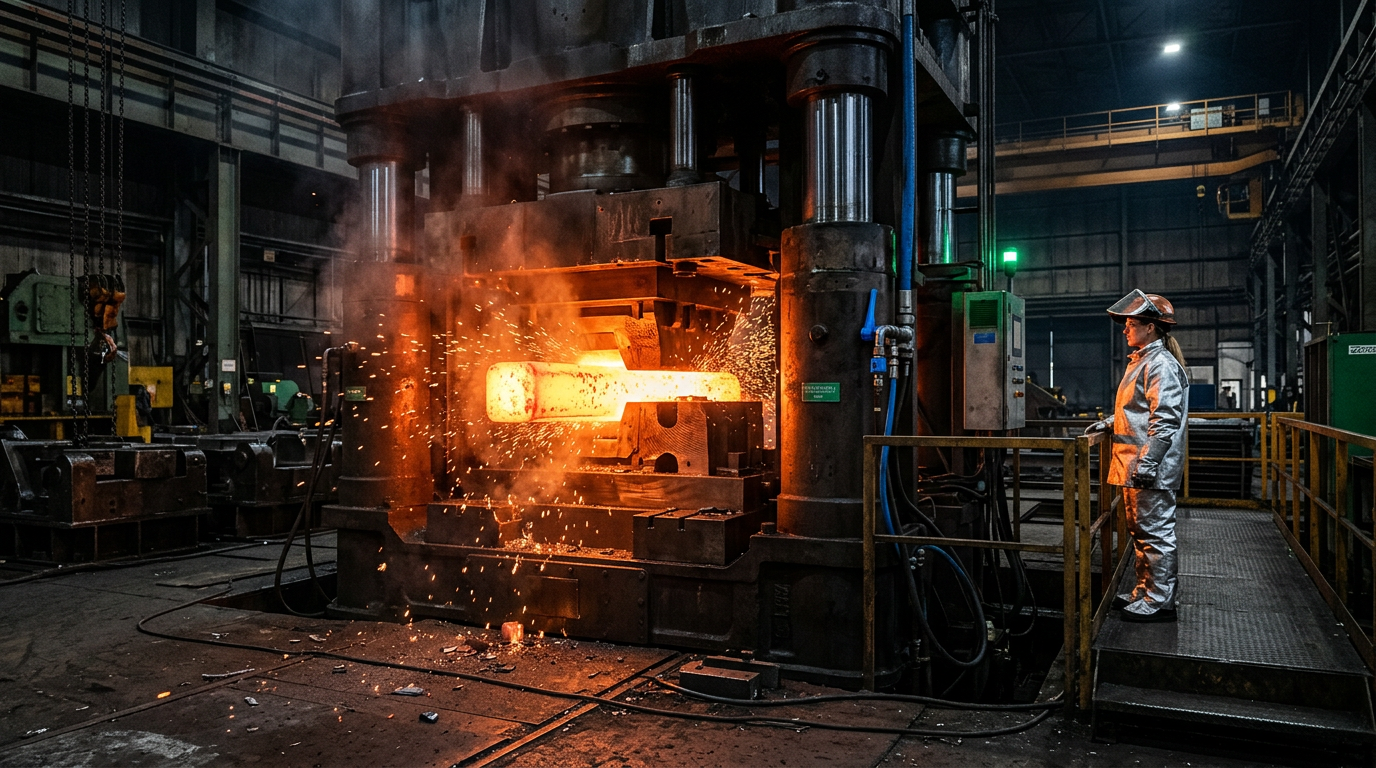
Regionally, Asia-Pacific maintains the largest market share due to manufacturing scale in China, India, and Southeast Asia, but North America and Europe are experiencing accelerating growth rates as governments prioritize domestic production and EV ecosystem development. The automotive sector accounts for approximately 40-45% of total demand, with energy, aerospace, industrial equipment, and construction comprising the remainder.
While carbon steel dominates by volume (35-40%), the value growth story is driven by specialized alloys in aerospace, defense, and EV applications. Premium materials command 3-5x higher margins, attracting forgers to build advanced capabilities.
The automotive industry's rapid shift toward electric vehicles represents the single most disruptive force in forging markets in 2026. EV platforms require fundamentally different drivetrain architectures compared to internal combustion engines (ICE), dramatically altering forging component demand profiles. Traditional engine-related forgings—including crankshafts, connecting rods, camshafts, and valve lifters—are declining as EV adoption accelerates, forcing many traditional suppliers to confront existential challenges.
Simultaneously, EV adoption creates substantial new opportunities. Electric drivetrains require specialized forged components including motor shaft assemblies, suspension arms, steering components, battery enclosure brackets, and high-strength structural elements. The intensity of EV charging infrastructure development also drives demand for forged electrical connectors, mounting hardware, and thermal management components. Early market leaders who successfully pivot to EV supply chains are capturing significant margin expansion opportunities.
Crankshafts, connecting rods, camshafts, and valve lifters are declining 3-5% annually. Traditional suppliers losing volume must pivot or face market exit.
Motor shafts, suspension arms, battery brackets growing 15-20% annually. Early movers are capturing premium margins and long-term OEM relationships.
The net effect for 2026 remains balanced. Global EV market penetration has reached approximately 15-20% of new vehicle sales, meaning ICE vehicle production still dominates numerically, but the trajectory is unmistakable. Forging companies that have established EV component certifications and production capabilities are reporting robust order pipelines, while those dependent on legacy engine components face pricing pressure and demand contraction. Government incentives for EV production—particularly in North America and Europe—are accelerating this transition beyond pure market forces.
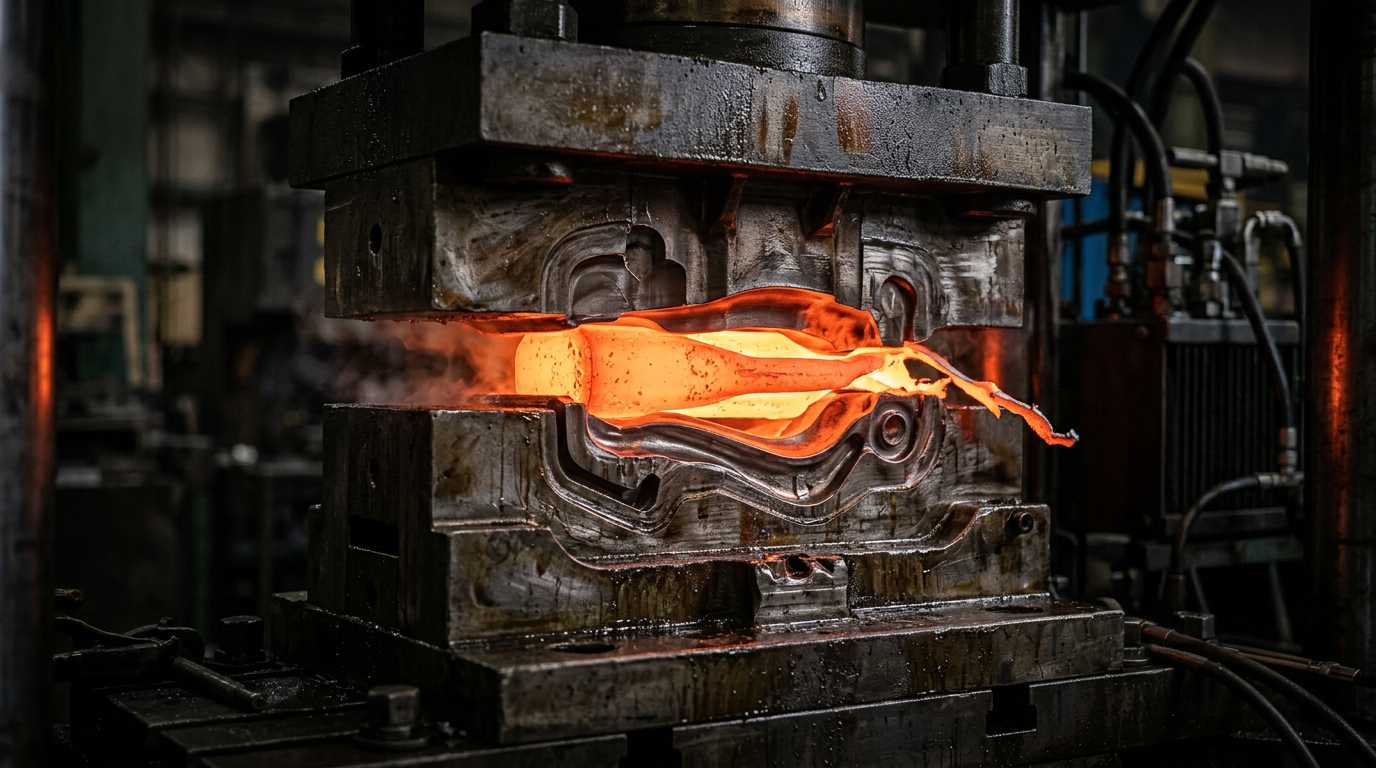
As manufacturing evolves toward lighter vehicles, more complex geometries, and stricter material specifications, closed-die forging is capturing an increasing share of production value. Closed-die (impression-die) forging produces near-net-shape components with minimal post-forging machining required, making it ideal for high-precision, high-volume applications where material waste reduction and dimensional consistency are critical. The EV transition further accelerates this trend, as EV manufacturers prioritize weight reduction and part consolidation—objectives best served by advanced closed-die technology.
In 2026, closed-die forging represents approximately 55-60% of the global forging market by value, up from roughly 45-50% five years prior. Premium EV component suppliers command pricing power precisely because they master closed-die processes capable of producing complex shapes with tolerances as tight as ±0.1mm on critical features. Meanwhile, open-die (free forging) maintains relevance for large structural forgings, one-off industrial components, and marine/energy applications where size and flexibility matter more than precision.
Technological advancement in closed-die forging includes automated die-change systems, advanced friction and heating control, and real-time defect detection using AI-powered vision systems. These capabilities enable shorter setup times, higher first-pass quality rates, and reduced scrap—directly improving profitability in increasingly competitive markets. Forging companies investing in closed-die modernization are positioning themselves to capture premium EV and aerospace work.
Digital transformation penetration in forging facilities has accelerated dramatically through 2026, driven by competitive necessity and software maturation. Industry 4.0 technologies—encompassing IoT sensors, real-time data analytics, machine learning, robotics, and cloud connectivity—are transitioning from competitive differentiators to baseline operational requirements. Modern forging shops now embed temperature sensors in dies, pressure transducers in presses, and vision systems on exit conveyors to monitor every critical process parameter.
The primary value drivers of Industry 4.0 adoption in forging are measurable: (1) reduced material waste through predictive die-life management, (2) improved quality consistency and reduced scrap rates by 10-25% through real-time process control, (3) predictive maintenance that reduces unexpected downtime, (4) energy optimization through better process visibility, and (5) faster setup and changeover times through automated documentation and die-tracking systems. A 2026 industry survey found that advanced forgers implementing comprehensive Industry 4.0 platforms report 15-20% improvements in overall equipment effectiveness (OEE).
15-20% OEE improvement, 10-25% scrap reduction, predictive maintenance, energy optimization, faster changeovers, real-time process control.
Supply chain visibility, customer traceability requirements met, defect detection automation, OEM partnership enablement, data-driven process innovation.
AI-driven process optimization has matured beyond research phases. Algorithms now learn from historical data to predict optimal heating profiles, press speeds, and cooling strategies for different part geometries and materials. Some leading facilities employ computer vision systems that automatically detect surface defects, inclusions, and geometry deviations in real time, enabling immediate corrective action rather than discovering problems in post-machining inspection. Integration with ERP and MES systems enables supply chain visibility and traceability—increasingly required for aerospace and defense customers.
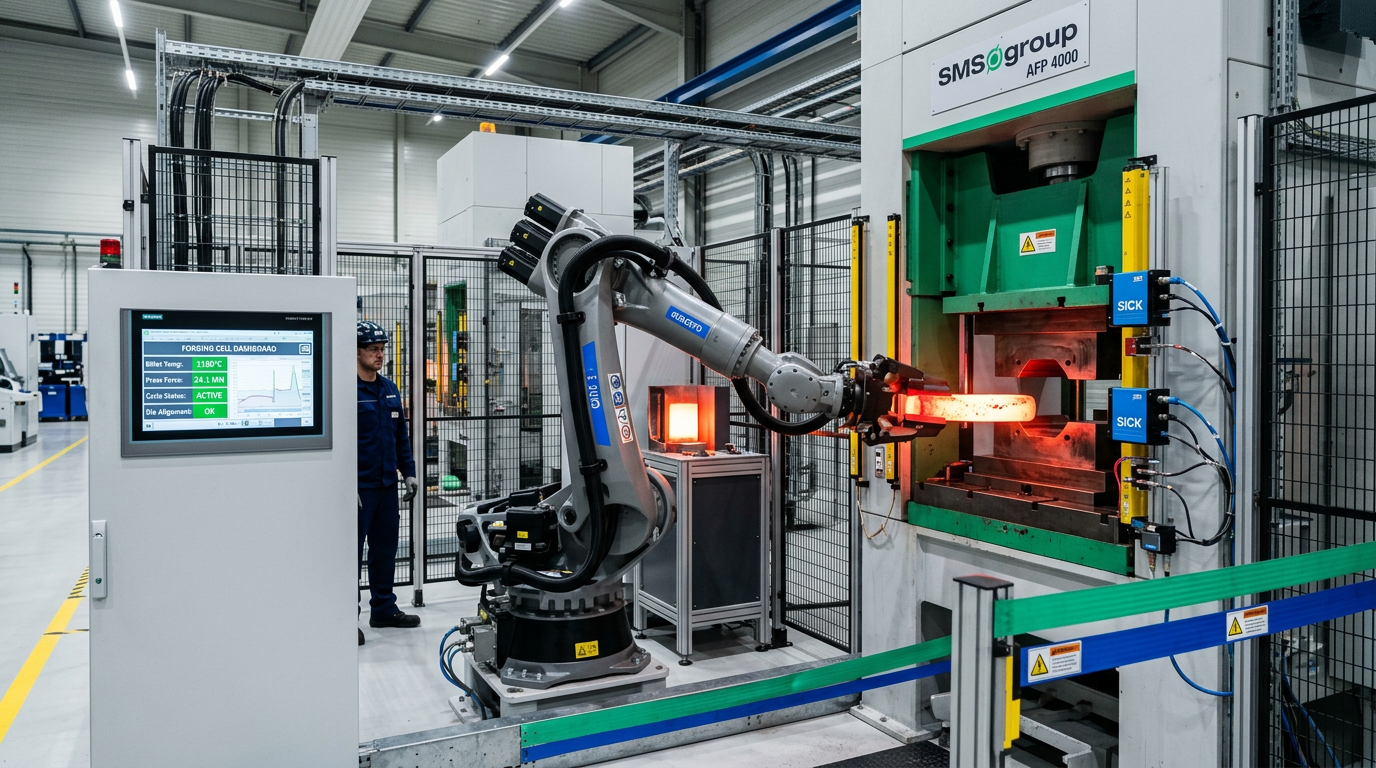
Comprehensive Industry 4.0 implementation requires 2-4 year payback but delivers sustained competitive advantage. Early adopters report customer retention improvements and ability to win precision/aerospace work unavailable to analog competitors.
The material composition of forged components is shifting markedly as automotive OEMs pursue weight reduction to improve EV range and efficiency. Carbon steel maintains numerical dominance—growing at 5.3% CAGR—but represents a declining share of total value as premium materials gain volume. Aluminum alloys (particularly 6061-T6, 6063, and specialized automotive grades) are experiencing accelerating adoption, growing at 7-8% CAGR. Titanium and titanium alloys, while niche in forging volume, are expanding 12-15% annually as aerospace and defense demand strengthens and automotive applications expand into safety-critical components.
The technical drivers are straightforward: a kilogram of aluminum weighs one-third that of steel while offering comparable strength in many applications. This weight advantage translates directly to EV range extension—a critical metric for consumer adoption. Titanium offers unmatched strength-to-weight ratios for high-stress environments, making it indispensable for aerospace landing gear, engine components, and emerging hypersonic applications. Advanced stainless steel grades (300M, 4340) remain critical for precision components requiring corrosion resistance and fatigue strength.
5.3% CAGR, 35-40% market volume, lower margin, higher volume, declining market share in value terms. Faces competition from lightweighting trends.
Aluminum 7-8% CAGR, Titanium 12-15% CAGR. Premium pricing, smaller volume, higher complexity, major capital investment required ($15-35M).
Forging aluminum and titanium presents distinct challenges compared to carbon steel. These materials require specialized heating equipment, precise temperature control throughout processing, different die materials, and advanced surface treatment capabilities. Capital investment to establish aluminum or titanium forging capability typically ranges $15-35 million for new facility construction. However, OEMs pay significant premiums for lightweighted components, justifying investment for suppliers capable of achieving consistent quality at scale. Regional material availability also influences strategy—North American and European forgers increasingly emphasize aluminum and specialty steel, while Asian competitors maintain cost advantages in carbon steel volume.
Successful forgers are not competing across all materials. Niche leaders specialize in aluminum for EV suspension, titanium for aerospace, or carbon steel for infrastructure. Specialization enables both technical excellence and customer relationship depth that commodity competition cannot match.
A critical structural shift underway in 2026 is the deliberate reshoring and nearshoring of forging capacity to North America. For two decades, forging manufacturing migrated overwhelmingly to lower-cost Asia, particularly China and India. Geopolitical tensions, supply chain vulnerability revealed during COVID-19, government incentives for domestic manufacturing, and labor cost normalization are reversing this trend for select segments. The U.S. Inflation Reduction Act provides substantial tax credits and grants for domestic EV component manufacturing, while the CHIPS and Science Act funds advanced manufacturing infrastructure. Canada and Mexico are also benefiting from nearshoring initiatives as OEMs rebalance supply chains for geopolitical resilience.
North American forging market growth is accelerating accordingly. The region is growing at 7-8% CAGR—significantly faster than the global 5.6% average—driven by EV supply chain development and traditional automotive growth recovery. New forging facilities are opening in the U.S. Midwest and Southeast, with particular concentration near EV battery gigafactories and automotive manufacturing clusters. Mexico is emerging as a critical nearshoring hub, with forging capacity expansion to serve both North American OEMs and Japanese/Korean suppliers establishing Mexican operations.
However, North American reshoring faces legitimate headwinds. Labor availability remains tight in manufacturing-skilled roles, wage expectations exceed many Asian competitors by 3-5x, and facility capital costs are substantially higher. Successful North American forgers differentiate through advanced technology adoption (Industry 4.0), premium quality capabilities (closed-die precision), and supply chain integration with OEM engineering teams. Companies established near EV manufacturing centers enjoy logistics advantages that partially offset labor cost premiums. This dynamic favors mid-sized, technology-advanced forgers over low-cost commodity producers.
Forging companies operating in 2026 face divergent futures depending on strategic positioning. The three critical strategic imperatives are: (1) technology leadership in closed-die precision and Industry 4.0 integration, (2) supply chain alignment with OEM electrification initiatives, and (3) geographic positioning in growth markets (North America and EV-focused regions). Companies excelling across these dimensions are capturing pricing power and volume growth. Those pursuing legacy strategies—focused on cost competition and traditional automotive supply—face margin compression and demand decline.
Investment priorities for competitive viability include: modernizing closed-die capability and equipment; implementing comprehensive Industry 4.0 architecture; establishing materials expertise in aluminum, titanium, and specialty alloys; obtaining and maintaining EV component certifications; and developing customer-facing technical services that position forgers as engineering partners rather than commodity suppliers. The suppliers winning in 2026 are those offering not just metals forgings, but integrated solutions that address OEM challenges around weight reduction, cost management, supply chain resilience, and design innovation.
Market consolidation continues as larger entities acquire mid-sized forgers to build scale and geographic diversification. However, successful niche players are those specializing in specific applications (aerospace forgings, EV motor shafts, precision medical equipment) where scale matters less than technical excellence and customer relationships. The 2026-2030 period will likely determine competitive outcomes for the next decade—companies that successfully navigate electrification, automation, and geographic rebalancing will thrive; those that don't will face existential pressure.
Related Resources:
Explore Forging Manufacturers |
Forging Manufacturers & Buyers Guide
Let's Talk.
Submit your project and receive responses from manufacturers that match your requirements.